EVM Portfolio API: A Complete Guide
Reading an EVM wallet means every chain it has touched, not just Ethereum — plus the receipt tokens, NFT positions and proxies that break naive decoding.
Chains and protocols in this guide
 Ethereum
 Base
Base BNB Chain
 Optimism
 Arbitrum
 Uniswap
 Aave
Aave WETH
WETH
"EVM support" sounds like one feature. It is not — it is the same integration problem repeated on every chain a wallet has ever touched, and the count is higher than most teams assume.
A single portfolio request for vitalik.eth returns value on 44 EVM chains,
out of 66 the response enumerates. Ethereum holds 93.2% of it. The other 43
chains hold $77,714 — the part a report either includes or silently loses.
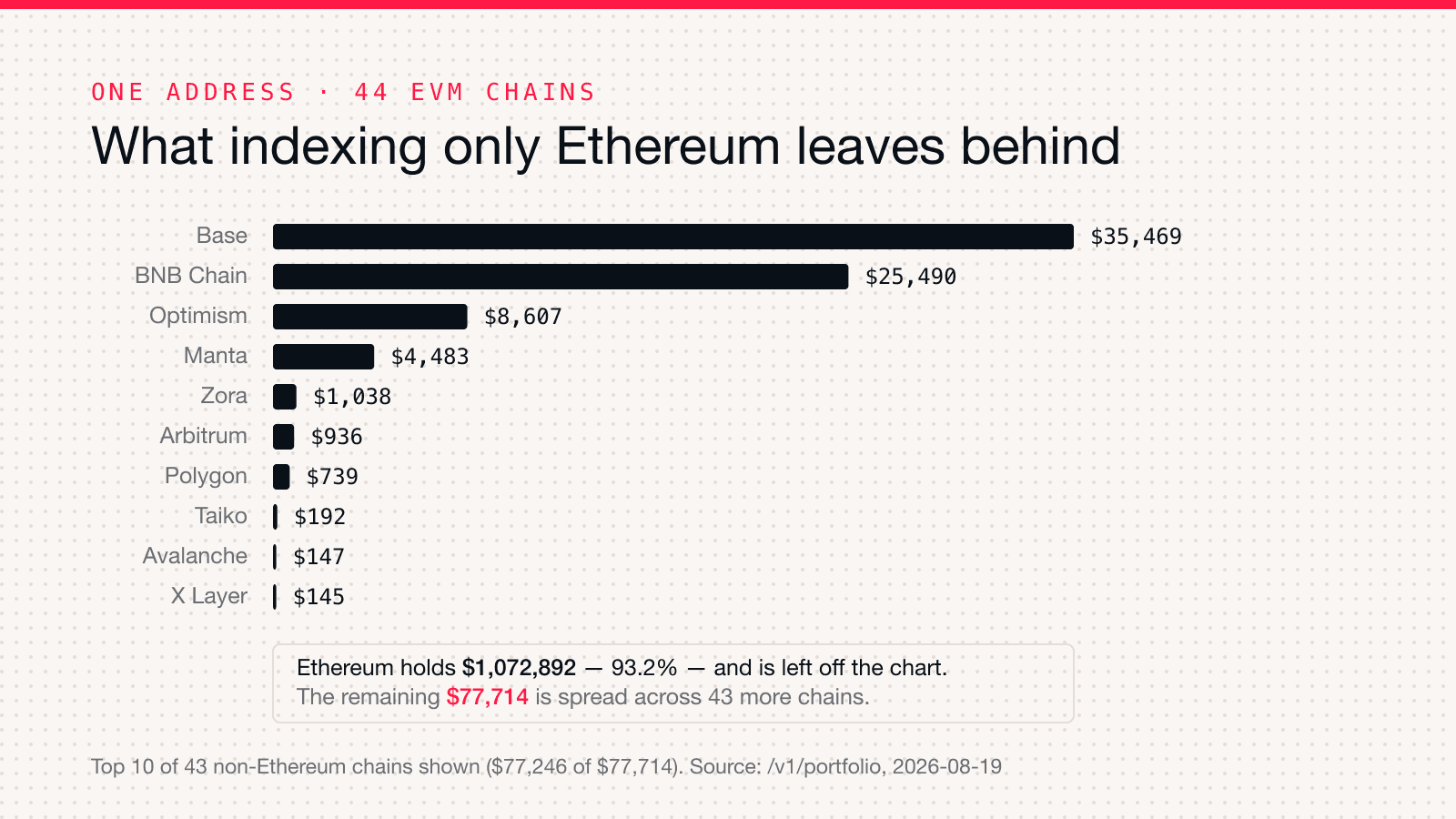
Ethereum is left off that chart on purpose. At linear scale it flattens everything else to nothing — which is exactly the mistake the chart is arguing against.
Why EVM is not one problem
Solana is one chain with hard-to-decode programs. EVM is the opposite: the decoding is well understood, and the difficulty is that you have to do it everywhere, forever.
| Solana | EVM | |
|---|---|---|
| Chains to index | 1 | Dozens, and rising |
| Same protocol, many deployments | Rare | Normal — Aave and Uniswap run on most L2s |
| Contract addresses | Stable per program | Different on every chain |
| New surface area | New programs | New chains and new protocols |
The multiplication is the whole story. Supporting Aave is one integration. Supporting Aave across chains is one integration re-verified on every chain it deploys to, because the addresses differ and the deployments drift.
Here is what that looks like in a real response — the same protocol, one wallet, two chains, five separate positions:
| Chain | Protocol | Position |
|---|---|---|
| Base | Uniswap V3 | DOGE / WETH |
| Base | Uniswap V3 | NMB404 / WETH |
| Ethereum | Uniswap V3 | DGENV2 / WETH |
| Ethereum | Uniswap V3 | BARK / WETH |
| Ethereum | Uniswap V3 | MIERDA / WETH |
An API that indexes Ethereum and calls it "Uniswap support" returns three of those five.
What actually sits in an EVM wallet
Four position types, only one of which a balance query returns correctly:
| Type | What it looks like on-chain | Naive result |
|---|---|---|
| Spot tokens | ERC-20 balance | Correct |
| Lending | Receipt token (aToken) + debt token | Debt counted as an asset |
| Liquidity | ERC-721 NFT (Uniswap V3) or LP ERC-20 | Missing, or valued at face |
| Vaults / staking | Share token whose price drifts from 1:1 | Undervalued |
The lending case is the one that inverts meaning rather than nudging a number. A wallet supplying 6,586 WETH against 2,294,767 USDC of borrow holds a net position near $10.3M — but summing the tokens it holds adds the debt as a positive and reports something closer to $12.6M. The mechanics are in Tracking Aave Positions.
The four things that break EVM decoding
Receipt tokens look like ordinary ERC-20s. aUSDC, cDAI, stETH and
thousands of vault shares are transferable tokens with a balance and a symbol.
Treat them as spot holdings and you double-count the underlying.
Liquidity is often not a token at all. A Uniswap V3 position is an NFT whose contents depend on the pool's current tick. There is no balance to read — the amounts have to be derived. See Valuing Uniswap V3 Positions.
Proxies hide the implementation. Most major EVM protocols sit behind upgradeable proxies, so the address you integrated against is not the logic you decoded. Upgrades change response shapes without changing addresses.
The same symbol is not the same asset. USDC on Ethereum, bridged USDC.e
on an L2 and a third-party bridge wrapper are different assets with different
risk. Collapsing them by symbol produces a tidy, wrong total.
Querying every chain in one request
The practical requirement is that chain count stops being your problem. One address in, every chain out:
curl -s https://api.octav.fi/v1/portfolio \
  -H "Authorization: Bearer $OCTAV_API_KEY" \
  -G --data-urlencode "addresses=0xd8dA6BF26964aF9D7eEd9e03E53415D37aA96045"
Positions come back grouped by protocol, then chain, so per-chain exposure is a read rather than a reconciliation. Batching several addresses into one request is also the main cost lever — the full parameter and credit table is in the endpoint reference.
If you would rather not hold a key at all while evaluating, Authless answers the same question for any EVM address with no account.
How to evaluate an EVM provider
Run these against a wallet whose contents you can verify independently. Each one fails a different class of provider:
- Query an address with activity on an L2 you rarely think about. Does the position appear at all? This is chain coverage, and it is where most of the variance lives.
- Query a wallet with an open lending borrow. Is the debt negative in the total, or added to it?
- Query a wallet with a Uniswap V3 position. Is it present, and are both sides of the pair itemised?
- Check a vault or staked position. Is it valued at the share price or at 1:1?
- Ask what happens on an unsupported protocol. "Omitted silently" and "flagged as unsupported" are very different products.
Question 1 is the one to weight. Decoding gaps are visible once you look; missing chains are invisible by construction, because nothing in the response says a chain was never checked.
Measured results across nine providers, including where competitors beat us, are in the benchmark — and the mechanism behind the disagreements is in Why Portfolio APIs Disagree.
Where to go next
| If you want | Go to |
|---|---|
| The general shape, not EVM-specific | Crypto portfolio API guide |
| The Solana equivalent of this page | Solana portfolio API guide |
| Every endpoint and credit cost | Endpoint reference |
| To evaluate providers properly | How to choose a crypto portfolio API |
| A working dashboard on this data | Build a portfolio dashboard |
| An AI agent to consume it | AI agent tools for portfolio data |
| A wallet's exact state at a past block | Portfolio at Block |
The multi-chain problem in the abstract — why enumeration is the hard part — is covered in Tracking DeFi Positions Across Multiple Chains.
Keep reading
 Chains
Solana Portfolio API: A Complete Guide
What it takes to read a Solana wallet properly — SPL tokens, staking, lending and perps — and why Solana coverage varies so much between providers.
2 min read
 API & Developers
Portfolio at Block: A Complete Guide
Query a wallet's exact decoded portfolio at any historical block on Ethereum, Linea and Monad — decoded Uniswap V4 everywhere, V3 on Linea.
3 min read
 AI Agents
Build an AI Agent That Alerts You on Your Positions
Install one MCP server and your AI assistant can watch your DeFi positions — liquidation risk, out-of-range liquidity — and tell you. No code required.
5 min read