The Crypto Portfolio API Benchmark: 9 Providers
We ran 17 real wallets through 9 crypto portfolio APIs and diffed the results. DeFi decoding moved reported net worth by 10x to 600x. Full scorecard inside.
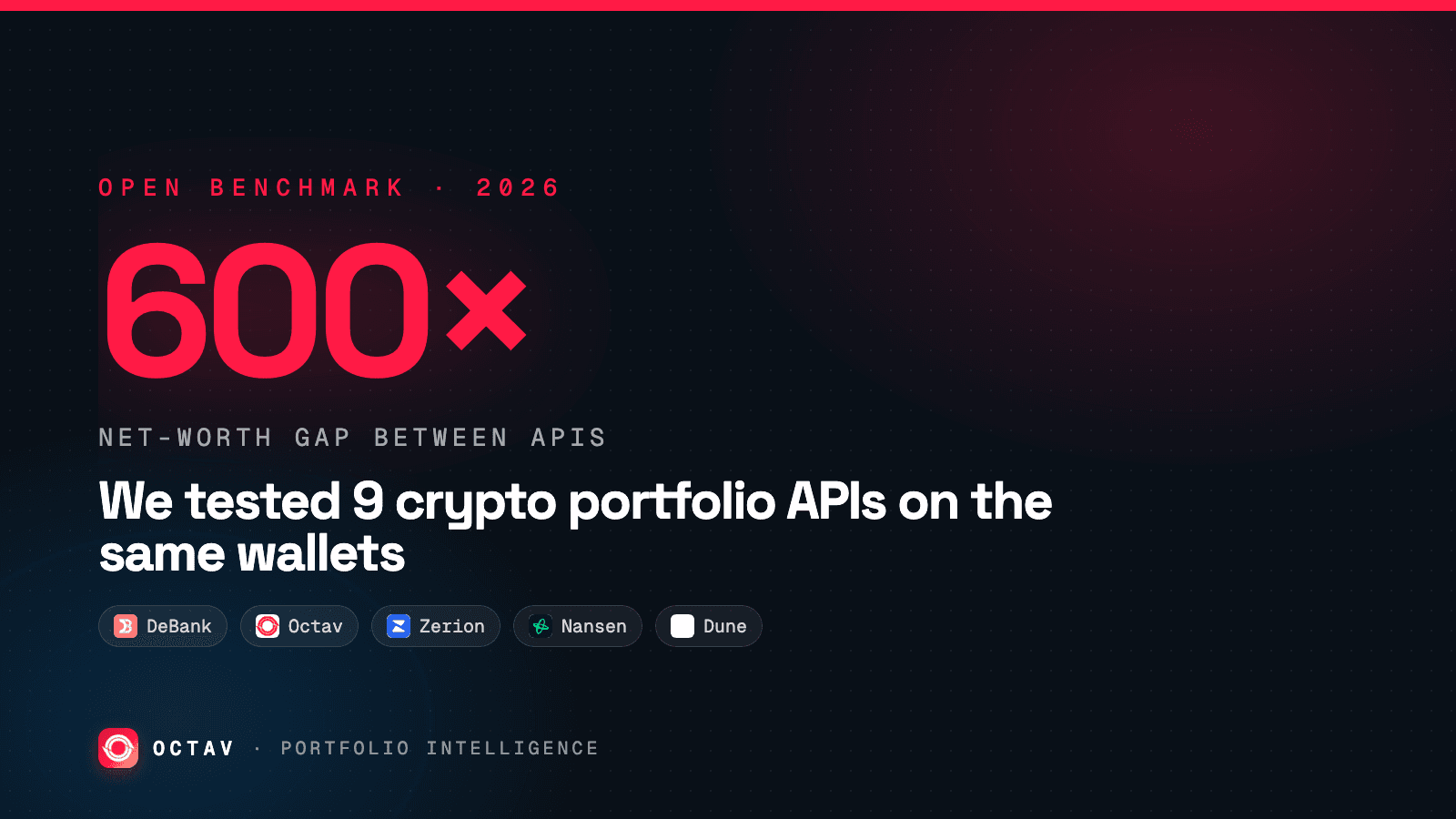
Portfolio APIs all promise the same thing: give us an address, we'll give you the portfolio. In practice they disagree wildly — on the same wallet, on the same day, by as much as 600×.
We built an open benchmark to find out why. Seventeen real-world wallet archetypes, nine providers, one shared entry point, no hand-typed numbers, captured as a time-aligned snapshot on 13 July 2026.
Disclosure: Octav is one of the nine providers measured, and we built the harness. The methodology is open and the raw data is published so you can re-run it. We also publish the results where competitors beat us — see the scorecard below.
The headline finding: DeFi decoding is the dividing line
The single biggest differentiator is not speed, price, or chain count. It is whether an API turns a wallet's on-chain positions — lending, LP, staking, perps, options — into a portfolio, or just lists raw token balances.
On the multi-sector whale wallet:
| API type | Reported net worth |
|---|---|
| Token-only APIs | $612.6k – $28.60M |
| Full-portfolio APIs | $46.27M |
That is not a pricing disagreement. On a clean single-protocol Aave wallet, every EVM API reconciles to within 0.2% — proof that the large gaps are coverage, not price-feed noise.
Reported net worth, same wallet, same day
Each row is scaled to its own maximum — these are four different wallets, so compare within a row, not across. Source: benchmark.octav.fi, 2026-07-13.
The scorecard
Each dimension is scored 0–100 from measured data; the overall is a weighted sum. Re-weight it for your use case and the order changes — that is the point of publishing the weights rather than just a ranking.
Weights: coverage 25% · DeFi decoding 20% · chain breadth 15% · cost 15% · performance 10% · developer experience 8% · tooling 5% · features 2%.
Crypto portfolio API — overall score
9 providers · 17 wallet archetypes · weighted across 8 dimensions
Source: benchmark.octav.fi, time-aligned snapshot 2026-07-13. Octav built the harness and is one of the nine measured.
DeBank edges the blended score, 85 to 82 — and it is bought entirely on cost and response time (79 and 69 against our 54 and 40). On everything that decides whether a portfolio figure is right, Octav is level or ahead: it ties DeBank for the maximum on both coverage and DeFi decoding, then pulls clear on developer experience (90, the highest measured), tooling (82) and features (75, the highest measured).
DeBank buys its speed by covering less — it is EVM only, with no Solana DeFi, options or perp decoding. Octav is the only provider here that resolves all three. Reweight the scorecard for a wallet that holds anything beyond EVM spot tokens and Octav is the most complete and most accurate API on the list.
What each provider is actually for
| Provider | Best at | Weak at |
|---|---|---|
| DeBank | EVM DeFi depth, balanced cost and speed | Tooling (40), no Solana DeFi depth |
| Octav | Most complete and accurate: ties the top coverage and decoding scores, and the only API that also decodes options, perps and Solana DeFi | Cost (54) and response time (40) |
| Zerion | Fastest and cheapest full portfolio | Coverage (48) on complex wallets |
| Mobula | Chain breadth (92) at low cost | Coverage (40) |
| TopLedger | Solana-native depth | Chain breadth (9) — Solana only |
| Zapper | Cheap DeFi decoding | Coverage (3) |
| Nansen | Analytics alongside portfolio | Cost (0) |
| Dune | Free token data, wide chains | No DeFi decoding (0) |
| GoldRush | Widest raw chain coverage (100) | No DeFi decoding (0), coverage (7) |
Three sectors almost nobody covers
Options. Only one of the nine decodes the Derive options book: $1.33M against roughly $401.6k elsewhere. The rest see the collateral and stop. See Decoding Derive Options in a Crypto Portfolio.
Perps. Hyperliquid and Lighter positions frequently vanish entirely. See Tracking Hyperliquid Perps in Your Portfolio.
Solana DeFi. Coverage is uneven and several providers have no Solana support at all. See Tracking Solana DeFi Positions in a Portfolio API.
How to read this if you are choosing an API
Ask what your wallets actually hold. If they are spot tokens on major EVM chains, most providers here will serve you and you should optimise for price and latency — Zerion scores 99 on cost and 92 on performance for a reason.
If your wallets hold lending positions, LP, staked assets, perps or options, coverage dominates everything else, because an API that misses a sector does not return a slightly wrong number. It returns a confidently wrong one.
For the mechanism behind the gaps, read Why Portfolio APIs Disagree About Your Net Worth. For a direct head-to-head of the top three, see Octav vs DeBank vs Zerion. For consumer-facing tools rather than APIs, see Best Crypto Portfolio Trackers in 2026.
More head-to-heads: Octav vs CoinStats, Octav vs Nansen, Octav vs Mobula, Octav vs CoinLedger and Octav vs Zerion.
For what these providers are being measured on — what a crypto portfolio API has to return, and how to query one — start with the guide.
Limitations
This is a snapshot of one day. Providers ship changes; coverage moves. The wallet set is seventeen archetypes, not a statistical sample of all wallets. The weights are a judgement call and we have published them so you can disagree with them. Re-run the harness rather than taking our word for it.
Keep reading
 Benchmarks & Comparisons
Octav vs Zerion: Which Sees More of Your Wallet
Zerion is fast and cheap but misses half a complex wallet. Octav decodes the full portfolio: DeFi, options, perps and Solana, with top benchmark coverage.
2 min read
 Benchmarks & Comparisons
Octav vs Mobula: Chain Breadth vs DeFi Depth
Mobula brings wide chain and market-data coverage at low cost. Octav decodes DeFi, options, perps and Solana with the top benchmark accuracy. Where each fits.
1 min read
 Benchmarks & Comparisons
Octav vs Nansen: Portfolio Data vs Analytics
Nansen is on-chain analytics: labels and smart-money flow. Octav is decoded portfolio data across DeFi, options, perps and Solana. Which one you actually need.
2 min read