Octav vs Zerion: Which Sees More of Your Wallet
Zerion is fast and cheap but misses half a complex wallet. Octav decodes the full portfolio: DeFi, options, perps and Solana, with top benchmark coverage.
Zerion is the fastest and cheapest full-portfolio option in our nine-provider benchmark. It is also the one with the biggest accuracy catch: on the same wallets, it scored 48 on coverage — it resolves under half of a complex wallet. For a plain spot wallet that is invisible. For anything holding real DeFi, it means the number is wrong.
Octav scored 100 on coverage on the identical wallets, and is the only provider tested that also decodes options, perps and Solana DeFi. When the portfolio has to be right, that gap is the whole story.
 Octav
Octav Zerion
What Zerion is good at
Credit where due: Zerion is a polished consumer wallet and a genuinely fast, cheap API — it topped the benchmark on cost (99) and performance (92). If your holdings are spot tokens on major chains, it will serve you and you will never notice its limits.
The catch: it misses more than half of a complex wallet
Coverage measures how much of a wallet a provider actually resolves. Zerion's 48 means that on an active wallet — lending, LP, staking, perps, options, Solana DeFi — more than half of the value can simply be absent from the response. It does not error. It returns a smaller, confident, wrong number.
Two accuracy failure modes show up when a tracker leans on a token-list view of a wallet instead of decoding positions:
- Missing positions. Whole sectors and chains go unresolved. This is what a coverage score of 48 looks like in practice.
- Double-counting receipts. A DeFi position leaves a receipt or wrapper token in the wallet — an aToken, an LP token, an LST. If a tracker counts that receipt and the underlying value it represents, the same money is booked twice. Octav resolves each receipt to its underlying position, so it is counted once, correctly — never as two holdings.
Between them, the result is a net-worth figure you cannot trust for reporting, tax or a product, because you cannot tell which lines are missing and which are doubled.
Octav vs Zerion, by the numbers
From the benchmark scorecard:
| Zerion | Octav | |
|---|---|---|
| Coverage | 48 | 100 |
| DeFi decoding | 100 | 100 |
| Options / perps / Solana DeFi | Partial | Full |
| Cost efficiency | 99 | 54 |
| Performance | 92 | 40 |
| Best for | Fast, cheap spot wallets | Accurate decoded portfolios |
Zerion wins on cost and speed; Octav wins on the one thing a portfolio has to be — complete and correct. See the full three-way in Octav vs DeBank vs Zerion.
The same data in the API or the app
Everything the Octav API returns is in the app too, free to use at pro.octav.fi. Search any address and read the full decoded portfolio across every chain it touches.
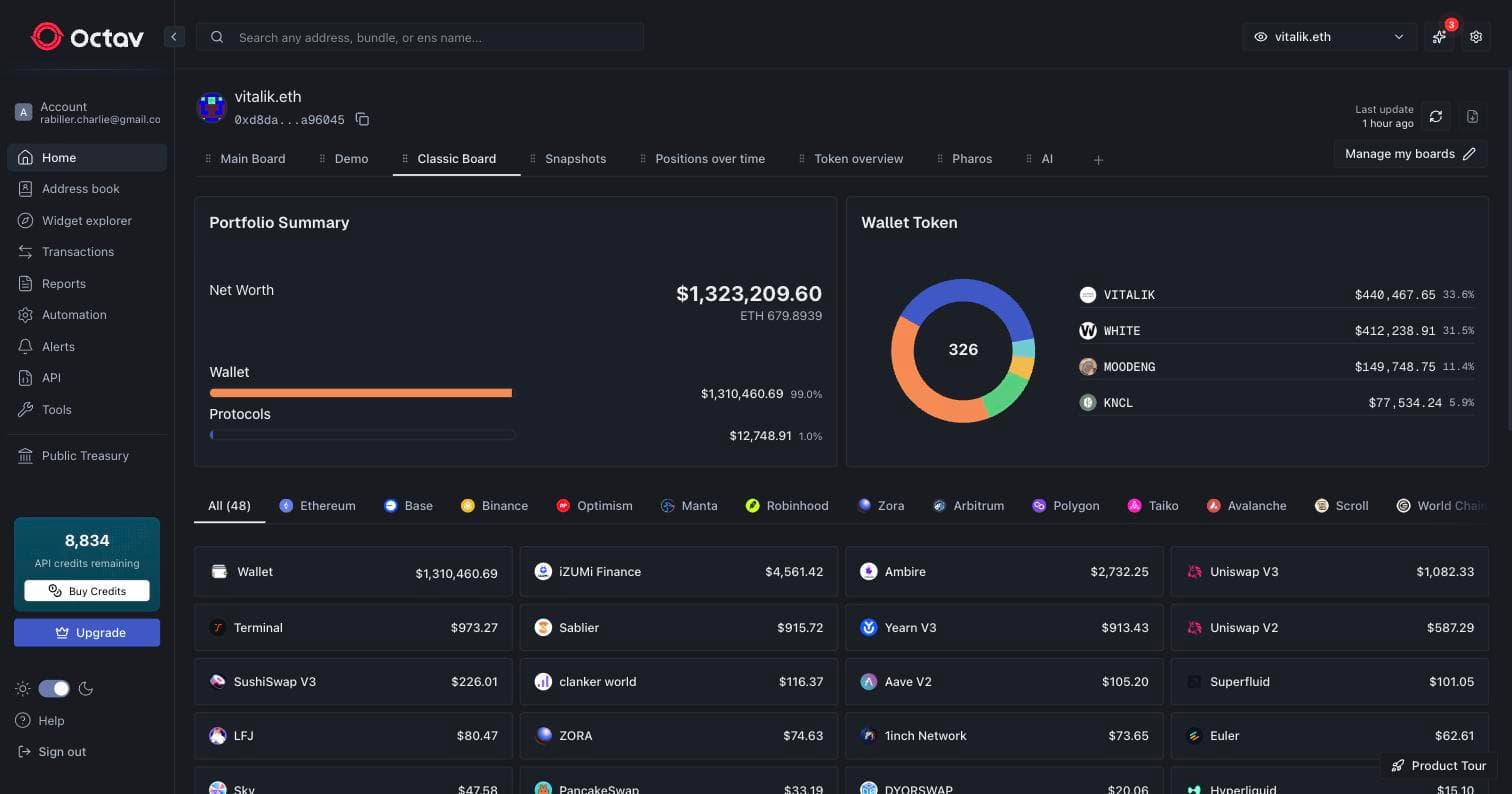
One wallet, 48 chains, every protocol position resolved individually and counted once — Aave, Yearn, Euler, Uniswap, Hyperliquid. That is the difference between a coverage of 100 and a coverage of 48.
Which should you pick?
- Zerion — a fast, cheap consumer wallet for simple, spot-heavy holdings.
- Octav — when the wallet holds real DeFi, options, perps or Solana and the number has to be right, as an API to build on or a free app to look at.
The benchmark harness is open and the weights are published, so you do not have to take our word for coverage 48 versus 100 — re-run it on your own wallets, or just check one at pro.octav.fi.
Keep reading
 Benchmarks & Comparisons
Octav vs Mobula: Chain Breadth vs DeFi Depth
Mobula brings wide chain and market-data coverage at low cost. Octav decodes DeFi, options, perps and Solana with the top benchmark accuracy. Where each fits.
1 min read
 Benchmarks & Comparisons
Octav vs Nansen: Portfolio Data vs Analytics
Nansen is on-chain analytics: labels and smart-money flow. Octav is decoded portfolio data across DeFi, options, perps and Solana. Which one you actually need.
2 min read
 Benchmarks & Comparisons
The Crypto Portfolio API Benchmark: 9 Providers
We ran 17 real wallets through 9 crypto portfolio APIs and diffed the results. DeFi decoding moved reported net worth by 10x to 600x. Full scorecard inside.
3 min read