Octav vs DeBank vs Zerion: Portfolio APIs
A measured head-to-head of the three top-scoring crypto portfolio APIs: DeFi depth, Solana, options, cost and latency, with the numbers behind each.
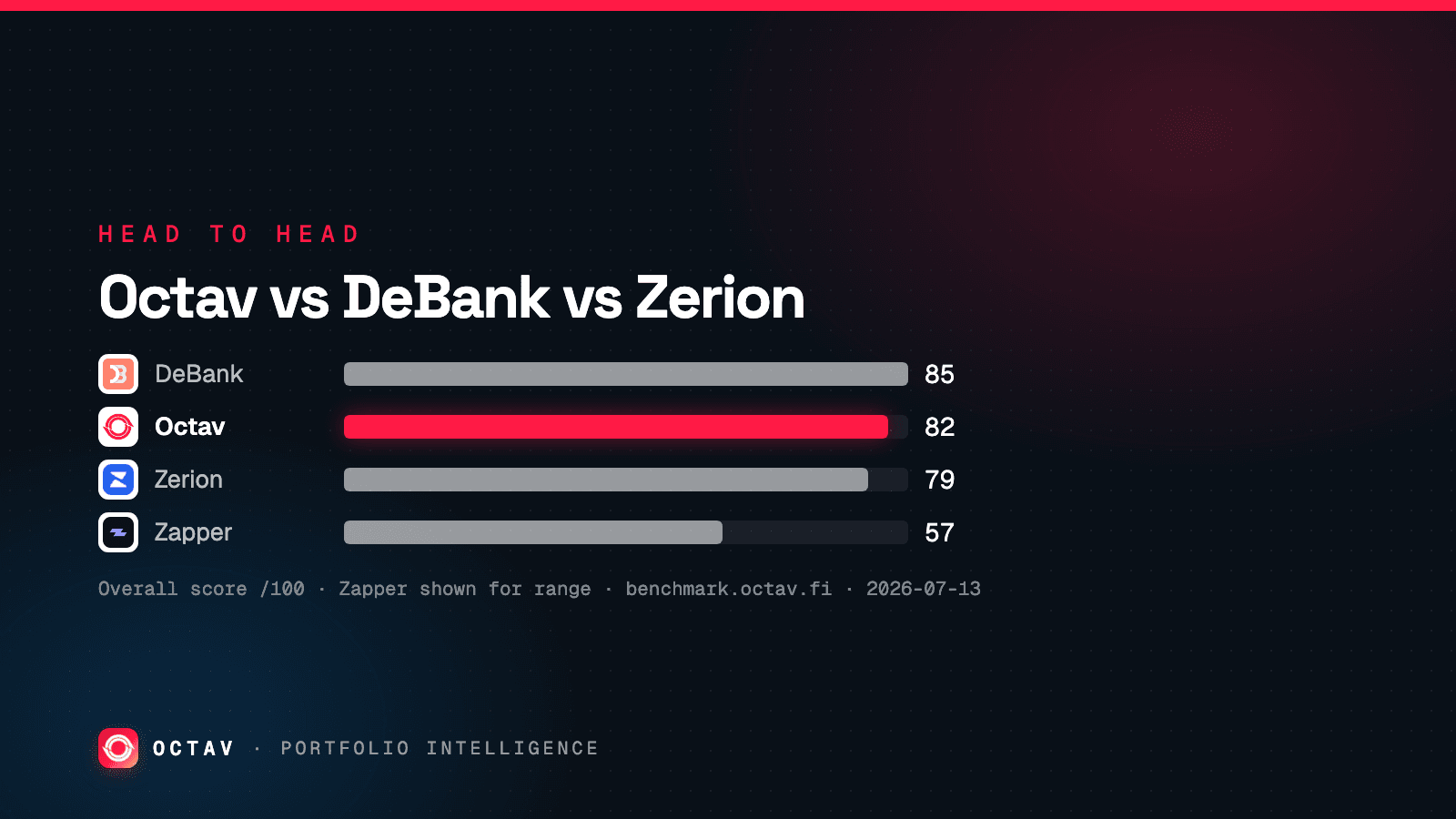
These three finished at the top of our nine-provider benchmark: DeBank 85, Octav 82, Zerion 79. The blended number is close, but it hides the thing that actually decides whether a portfolio figure is right — how much of a real wallet each one resolves, and how accurately. On that axis Octav is the most complete: it ties DeBank for the top coverage and DeFi-decoding scores, and it is the only one of the three that also decodes options, perps and Solana DeFi.
Disclosure: Octav is one of the three. We built the benchmark harness and publish the methodology, the weights and the results where we lose.
The short version
| DeBank | Octav | Zerion | |
|---|---|---|---|
| Overall | 85 | 82 | 79 |
| Coverage | 100 | 100 | 48 |
| DeFi decoding | 100 | 100 | 100 |
| Chain breadth | 80 | 78 | 69 |
| Cost efficiency | 79 | 54 | 99 |
| Performance | 69 | 40 | 92 |
| Developer experience | 78 | 90 | 88 |
| Tooling | 40 | 82 | 86 |
| Features | 63 | 75 | 50 |
Read that as three different bets:
- Octav — the most complete. Ties the top coverage and decoding scores, and the only one that also resolves options, perps and Solana DeFi in the same call. If a figure has to be right, this is the safe default.
- DeBank — the EVM specialist. Full EVM DeFi coverage at balanced cost and speed, but EVM only: no Solana DeFi, options or perp decoding.
- Zerion — the fastest and cheapest. Fine if your wallets are simple; its coverage score of 48 means it resolves under half of a complex one.
Where the coverage difference shows up
Coverage only matters when a wallet holds something unusual. On a plain token wallet all three agree to within a fraction of a percent. The gaps appear by sector:
| Sector | DeBank | Octav | Zerion |
|---|---|---|---|
| EVM tokens | Full | Full | Full |
| EVM lending / LP / staking | Full | Full | Partial |
| Perps (Hyperliquid, Lighter) | Partial | Full | Partial |
| Options (Derive) | Collateral only | Full | Collateral only |
| Solana DeFi | None | Full | Partial |
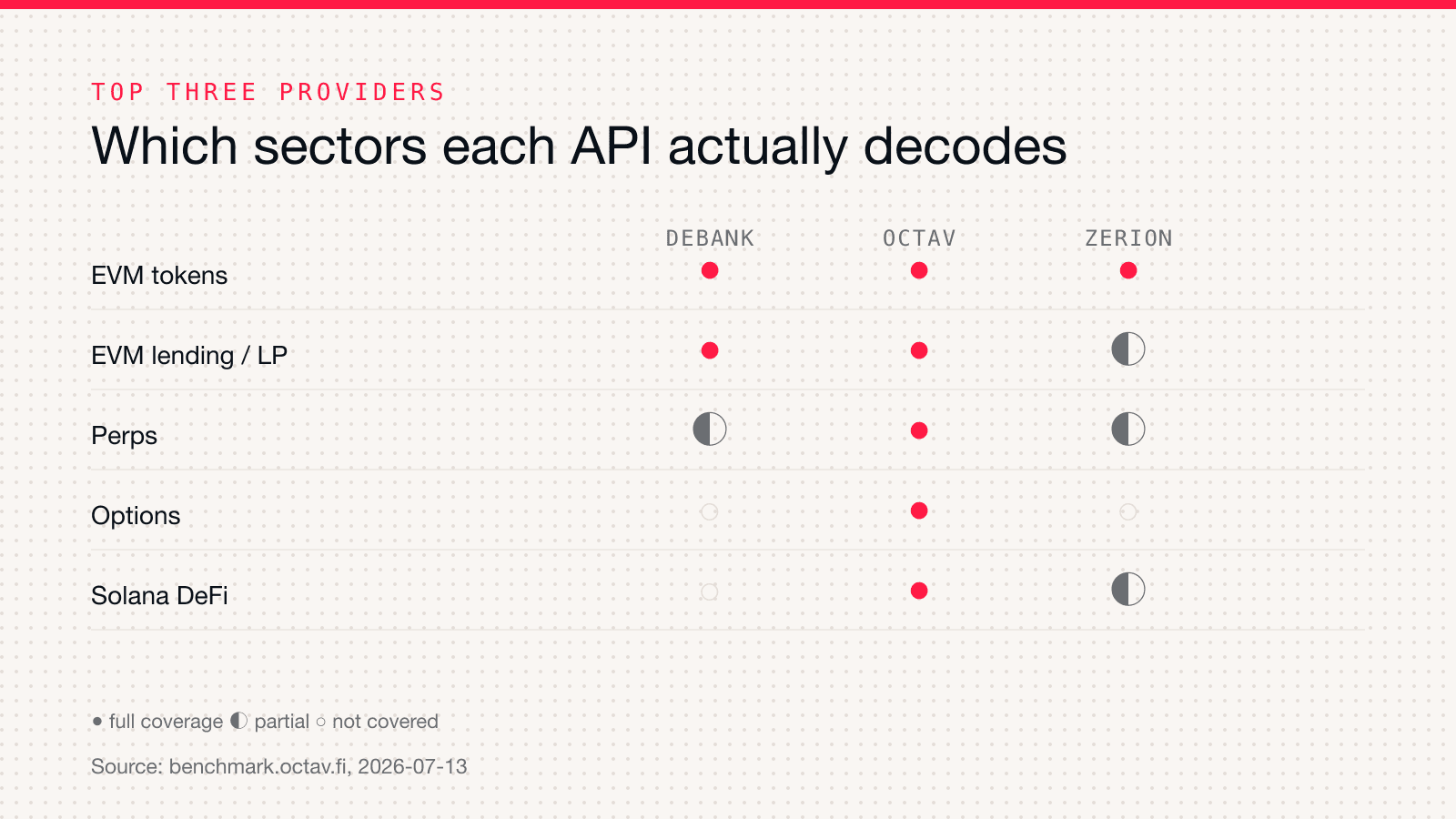
The options line is the starkest: on the Derive book, full decoding reports $1.33M where collateral-only reads report about $401.6k. That is not a rounding difference, it is a different answer to "what do I own".
Where Octav loses
Two dimensions, and they are real:
Cost — 54 vs Zerion's 99. Octav is credit-based at roughly $0.020–$0.025 per credit, with most endpoints costing one credit. Zerion is materially cheaper per call. If you are polling thousands of simple wallets on a loop, that difference compounds fast — as long as those wallets stay simple. Point Zerion at anything with real DeFi and it resolves under half of it (coverage 48), so the saving buys you a wrong number.
Performance — 40 vs Zerion's 92. Decoding positions across many protocols costs time. If you need sub-second responses in a user-facing hot path, budget for caching or pick a faster provider. Portfolio responses cache for one minute; transactions for ten.
We would rather publish that than have you discover it in week two of an integration.
Where Octav wins
Developer experience — 90, the highest measured. One call, Bearer-key auth, tokens and every decoded DeFi position returned in a single predictable shape, across 19 endpoints. See the endpoint reference.
Tooling — 82 vs DeBank's 40. An MCP server, a Rust CLI and x402, a no-code widget builder, daily snapshots and public transparency dashboards.
Sector completeness. Options, perps and Solana DeFi from one integration rather than three providers stitched together.
Which one should you pick
| If you… | Pick |
|---|---|
| Track simple token wallets at high volume | Zerion |
| Need EVM DeFi depth with balanced cost and speed | DeBank |
| Hold options, perps or Solana DeFi | Octav |
| Need one integration covering every sector | Octav |
| Optimise purely for latency | Zerion |
Re-weight the scorecard and the order shifts on cost and speed — but coverage and accuracy do not move. For any wallet beyond simple EVM spot tokens, Octav resolves the most of it, most accurately, which is why it is the safe default when the number has to be right. We published the weights so you can prove that for your own wallets rather than take our word for it.
Keep reading
 Benchmarks & Comparisons
Octav vs Zerion: Which Sees More of Your Wallet
Zerion is fast and cheap but misses half a complex wallet. Octav decodes the full portfolio: DeFi, options, perps and Solana, with top benchmark coverage.
2 min read
 Benchmarks & Comparisons
Octav vs Mobula: Chain Breadth vs DeFi Depth
Mobula brings wide chain and market-data coverage at low cost. Octav decodes DeFi, options, perps and Solana with the top benchmark accuracy. Where each fits.
1 min read
 Benchmarks & Comparisons
Octav vs Nansen: Portfolio Data vs Analytics
Nansen is on-chain analytics: labels and smart-money flow. Octav is decoded portfolio data across DeFi, options, perps and Solana. Which one you actually need.
2 min read