A Rust CLI for Crypto Portfolio Data
Query multi-chain portfolios, transactions and NAV from the terminal with a single Rust binary — built for shell pipelines, CI jobs and sandboxed AI agents.
octav-cli exposes the full Octav API from the terminal. It is written in Rust, which matters for one practical reason: it is a single static binary with no runtime to install.
That is the difference between "add a dependency, pin a version, keep an SDK in sync" and "drop a binary in the container".
Basic use
export OCTAV_API_KEY="your-key"

octav portfolio 0xd8dA6BF26964aF9D7eEd9e03E53415D37aA96045
octav nav 0xd8dA6BF26964aF9D7eEd9e03E53415D37aA96045
octav transactions 0xYourAddress --limit 50 --chain ethereum
Output is JSON, which is the point — it composes with everything else.
Where a CLI beats an SDK
Shell pipelines. Exposure by chain, with no application code:
octav portfolio 0xYourAddress \
  | jq -r '.positions[] | "\(.chain)\t\(.value)"' \
  | awk -F'\t' '{s[$1]+=$2} END {for (c in s) printf "%-12s %12.2f\n", c, s[c]}' \
  | sort -k2 -nr
Scheduled jobs. A cron entry that writes a daily NAV to a file is three lines and needs no project scaffolding:
0 0 * * * octav nav $ADDRESSES >> /var/log/nav-$(date +\%F).jsonCI checks. Fail a pipeline if a treasury address drifts outside expected
bounds — a shell script with jq and an exit code, not a service.
Sandboxed AI agents. An agent with shell access can call the CLI without you writing tool definitions. No SDK to install in the sandbox, no language runtime assumption, and the same invocation works from any language's subprocess call. This is why it sits in the agent toolkit alongside the MCP server.
Batching matters
The single biggest cost lever is passing multiple addresses to one invocation rather than looping:
# One credit, three wallets, one round trip
octav portfolio 0xAddressOne,0xAddressTwo,0xAddressThree

# Three credits, three round trips — avoid
for a in 0xOne 0xTwo 0xThree; do octav portfolio "$a"; done
Rate limiting is 360 requests per minute per key and is shared across every access method, so a CLI loop and a running application draw on the same budget.
What it returns
The same decoded data as the REST API — tokens plus every DeFi position, including Solana, perps and options — in one response shape. Full surface in the endpoint reference.
Choosing between the front doors
| You are | Use |
|---|---|
| Writing a backend service | The REST API |
| Scripting, in CI, or at a prompt | The CLI |
| Running an agent in Claude or Codex | The MCP server |
| Running an unprovisioned autonomous agent | x402 |
All four read the same data. See Every Octav Tool and When to Use It.
Keep reading
 AI Agents
AI Agent Tools for Crypto Portfolio Data
A survey of how AI agents get on-chain data — MCP servers, agent skills, CLIs and pay-per-call rails — and the failure modes specific to autonomous consumption.
2 min read
 AI Agents
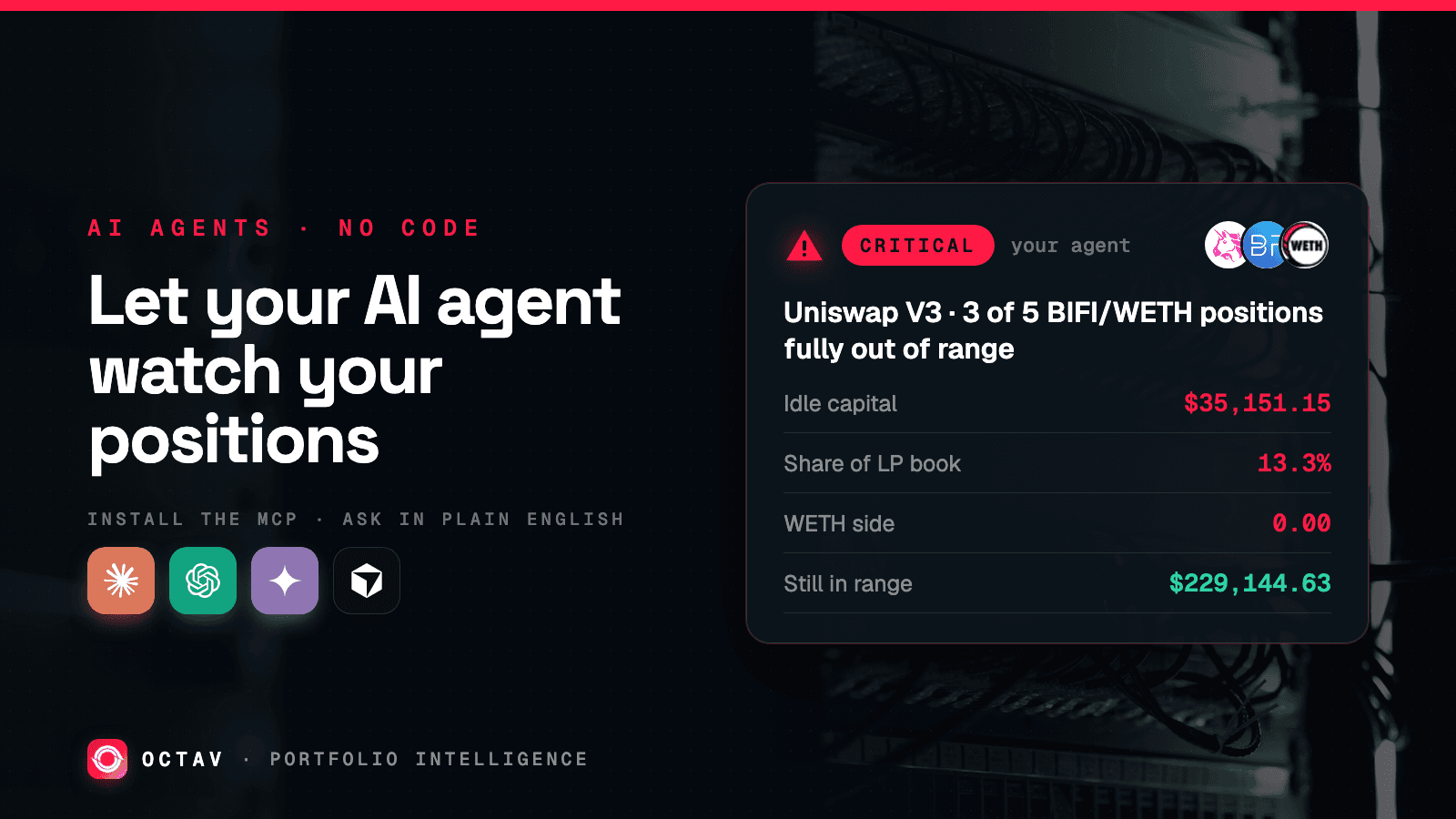
Build an AI Agent That Alerts You on Your Positions
Install one MCP server and your AI assistant can watch your DeFi positions — liquidation risk, out-of-range liquidity — and tell you. No code required.
5 min read
 AI Agents
A Crypto Portfolio MCP Server for AI Agents
How to give Claude, Codex or Gemini live on-chain portfolio data through an MCP server, and why token-only APIs make agents confidently wrong about wallets.
2 min read