AI Agent Tools for Crypto Portfolio Data
A survey of how AI agents get on-chain data — MCP servers, agent skills, CLIs and pay-per-call rails — and the failure modes specific to autonomous consumption.
Giving an AI agent access to crypto data is now a solved integration problem and an unsolved reliability problem. The plumbing is straightforward; the hard part is that agents cannot tell when the data they received was incomplete.
The four integration rails
| Rail | Shape | Best when |
|---|---|---|
| MCP server | Tools exposed to the model | The agent runs in Claude, Codex, Gemini |
| Agent skill | Structured instructions | You want the agent to learn an API's conventions |
| CLI | A binary the agent shells out to | Sandboxed agents, shell-native workflows |
| x402 | Pay-per-request over HTTP 402 | Autonomous agents with no provisioned key |
These are complements, not competitors. An agent in an IDE wants MCP; an agent in a CI job wants a CLI; an agent you did not provision wants x402.
For a step-by-step build on the same data, see Build a Crypto Portfolio Dashboard.
Octav ships all four — MCP server, agent skill, Rust CLI and x402 — which is a large part of why the benchmark scored it 82 on tooling against DeBank's 40.
Three failure modes specific to agents
Silent omission is worse for agents. A human looking at a portfolio notices their Kamino loan is missing. An agent has no prior — it treats the response as the complete state of the world and reasons confidently from a subset. Given a token-only API, an agent will produce a fluent, well-structured analysis of a portfolio that does not exist.
Loops are expensive. Agents iterate willingly. A poorly-scoped task can generate thousands of calls. Two defences: batch addresses into a single request rather than iterating, and lean on caching — portfolio responses cache for one minute, transactions for ten. Rate limiting is 360 requests per minute per key.
Stale data reads as current. An agent asked "what is this portfolio worth"
will not think to ask when the data was indexed. Exposing a freshness signal —
/v1/status returns sync state — lets the agent check rather than assume.
What makes an API agent-friendly
Beyond the transport, a few properties matter disproportionately when the consumer is a model rather than a person:
- One predictable response shape across every position type. Agents handle uniform structures far better than sector-specific special cases.
- Explicit units and price sources, so the agent is not inferring whether a number is tokens or dollars.
- Errors that say what to do. A 402 that says "insufficient credits" is actionable; a bare 500 is not.
- Discovery endpoints.
/v1/chainsand/v1/chains/{key}/protocolslet an agent establish what is supported before querying, rather than guessing and failing.
Machine-readable content, not just APIs
The same argument applies to documentation and written content. Agents fetching a rendered marketing page pay for layout markup they cannot use.
This blog serves a markdown version of every article at <url>.md and an index
at /llms.txt — the article you are reading is roughly 94% smaller
in that form. That is not a courtesy; it is the difference between an article
being read in full and being truncated.
Where this is going
The interesting shift is agents that act on portfolio data rather than summarising it — rebalancing, monitoring liquidation risk, reconciling transactions. Each of those raises the cost of incomplete data from "embarrassing" to "expensive", which is why coverage, not convenience, is the thing to evaluate first. See the portfolio API benchmark.
The monitoring case is worked through end to end, with polling code and real positions, in Build an AI Agent That Alerts You on Your Positions.
Keep reading
 AI Agents
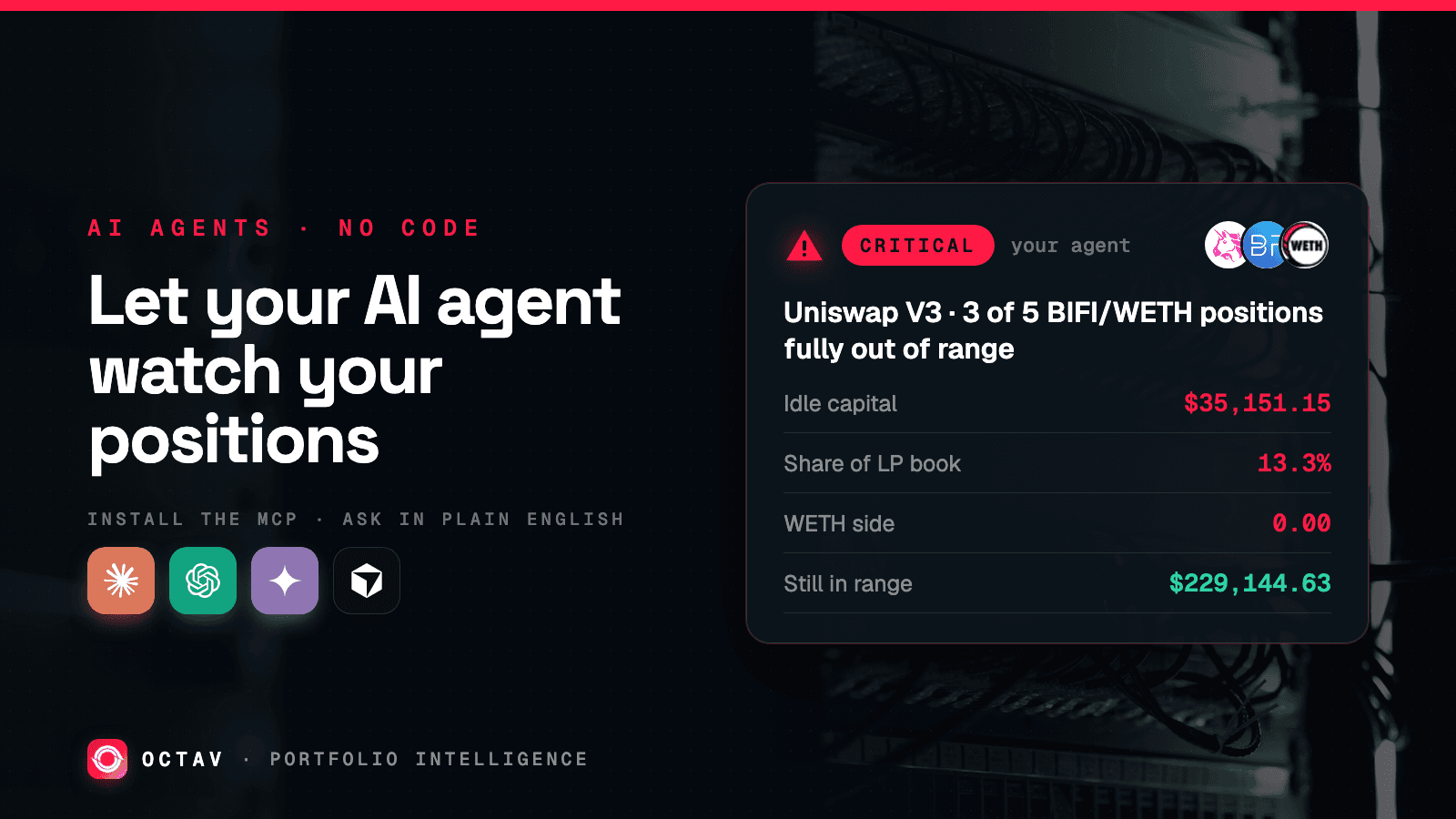
Build an AI Agent That Alerts You on Your Positions
Install one MCP server and your AI assistant can watch your DeFi positions — liquidation risk, out-of-range liquidity — and tell you. No code required.
5 min read
 AI Agents
A Crypto Portfolio MCP Server for AI Agents
How to give Claude, Codex or Gemini live on-chain portfolio data through an MCP server, and why token-only APIs make agents confidently wrong about wallets.
2 min read
 AI Agents
x402: Pay-Per-Call API Access for Agents
How the HTTP 402 status code lets an autonomous agent pay for an API request inline, removing the need to provision and manage a long-lived API key.
2 min read