Octav vs Mobula: Chain Breadth vs DeFi Depth
Mobula brings wide chain and market-data coverage at low cost. Octav decodes DeFi, options, perps and Solana with the top benchmark accuracy. Where each fits.
Mobula and Octav both offer a portfolio API, and both were measured in our nine-provider benchmark — which makes the comparison unusually concrete. Mobula's edge is chain breadth and market data at low cost. Octav's edge is decoding accuracy: reading what a wallet actually holds inside protocols, which is where the value hides.
The numbers make the trade-off plain: on the same wallets, Mobula scored 92 on chain breadth but 40 on coverage, while Octav scored 100 on coverage and the maximum on DeFi decoding.
 Octav
Octav Mobula
Breadth is not the same as coverage
Chain breadth counts how many networks a provider touches. Coverage measures how much of a wallet it actually resolves. A provider can index dozens of chains and still miss most of an active wallet's value, because that value lives in lending positions, LP, staking, perps and options — protocol state that a market-data pipeline is not built to decode.
| Mobula | Octav | |
|---|---|---|
| Chain breadth (benchmark) | 92 | 78 |
| Coverage (benchmark) | 40 | 100 |
| DeFi decoding | Partial | Full |
| Options / perps / Solana DeFi | Limited | Fully decoded |
| Cost | Low | Credit-based, free tier |
| Best for | Wide token/market data, cheap | Accurate decoded portfolios |
The same data in the API or the app
Everything the Octav API returns is in the app too, free to use at pro.octav.fi. Search any address and see the full decoded portfolio across every chain it touches.
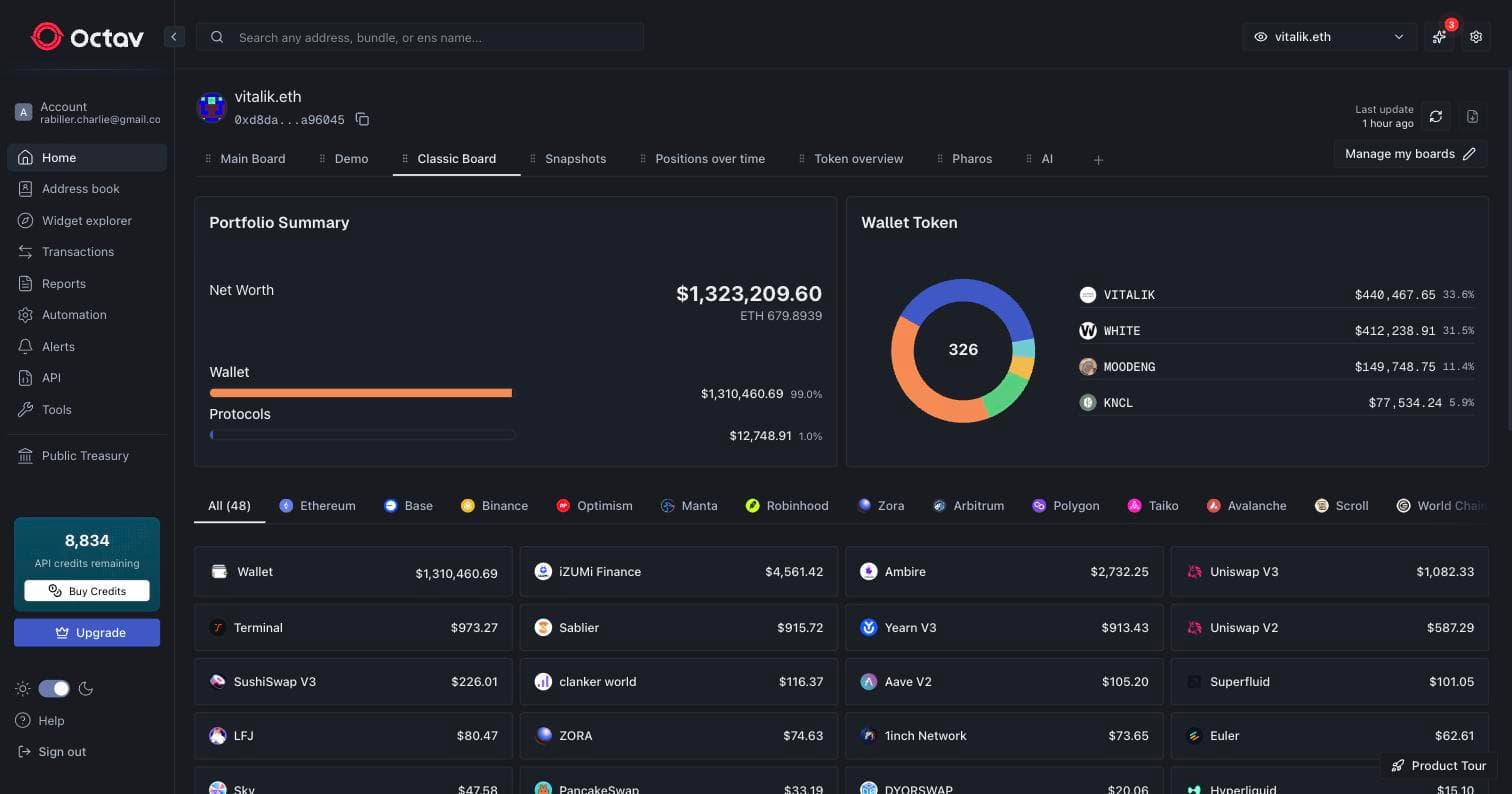
Aave, Yearn, Euler, Uniswap and Hyperliquid positions resolved individually — this is what a coverage score of 100 looks like next to a market-data feed's 40.
Why Octav wins where it counts
If your wallets hold nothing but spot tokens on many chains, Mobula's breadth and price are a reasonable fit. The moment a wallet holds real DeFi — which is most active wallets — coverage dominates everything else, and a provider that misses a sector returns a confidently wrong number. See why portfolio APIs disagree and tracking DeFi positions across chains.
Octav's decoding lead is measured, not claimed: the benchmark harness is open and the weights are published, so you can re-run it on your own addresses.
Which should you pick?
- Mobula — for wide, cheap token and market data where deep DeFi decoding is not the point.
- Octav — when the portfolio has to be accurate: DeFi, options, perps and Solana decoded, as an API or a free app.
Try any wallet at pro.octav.fi, or read the full benchmark.
Keep reading
 Benchmarks & Comparisons
Octav vs Zerion: Which Sees More of Your Wallet
Zerion is fast and cheap but misses half a complex wallet. Octav decodes the full portfolio: DeFi, options, perps and Solana, with top benchmark coverage.
2 min read
 Benchmarks & Comparisons
Octav vs Nansen: Portfolio Data vs Analytics
Nansen is on-chain analytics: labels and smart-money flow. Octav is decoded portfolio data across DeFi, options, perps and Solana. Which one you actually need.
2 min read
 Benchmarks & Comparisons
The Crypto Portfolio API Benchmark: 9 Providers
We ran 17 real wallets through 9 crypto portfolio APIs and diffed the results. DeFi decoding moved reported net worth by 10x to 600x. Full scorecard inside.
3 min read