Why Portfolio APIs Disagree About Net Worth
Two crypto portfolio APIs can report a 600x difference for the same wallet on the same day. The cause is almost never pricing — it is what they can decode.
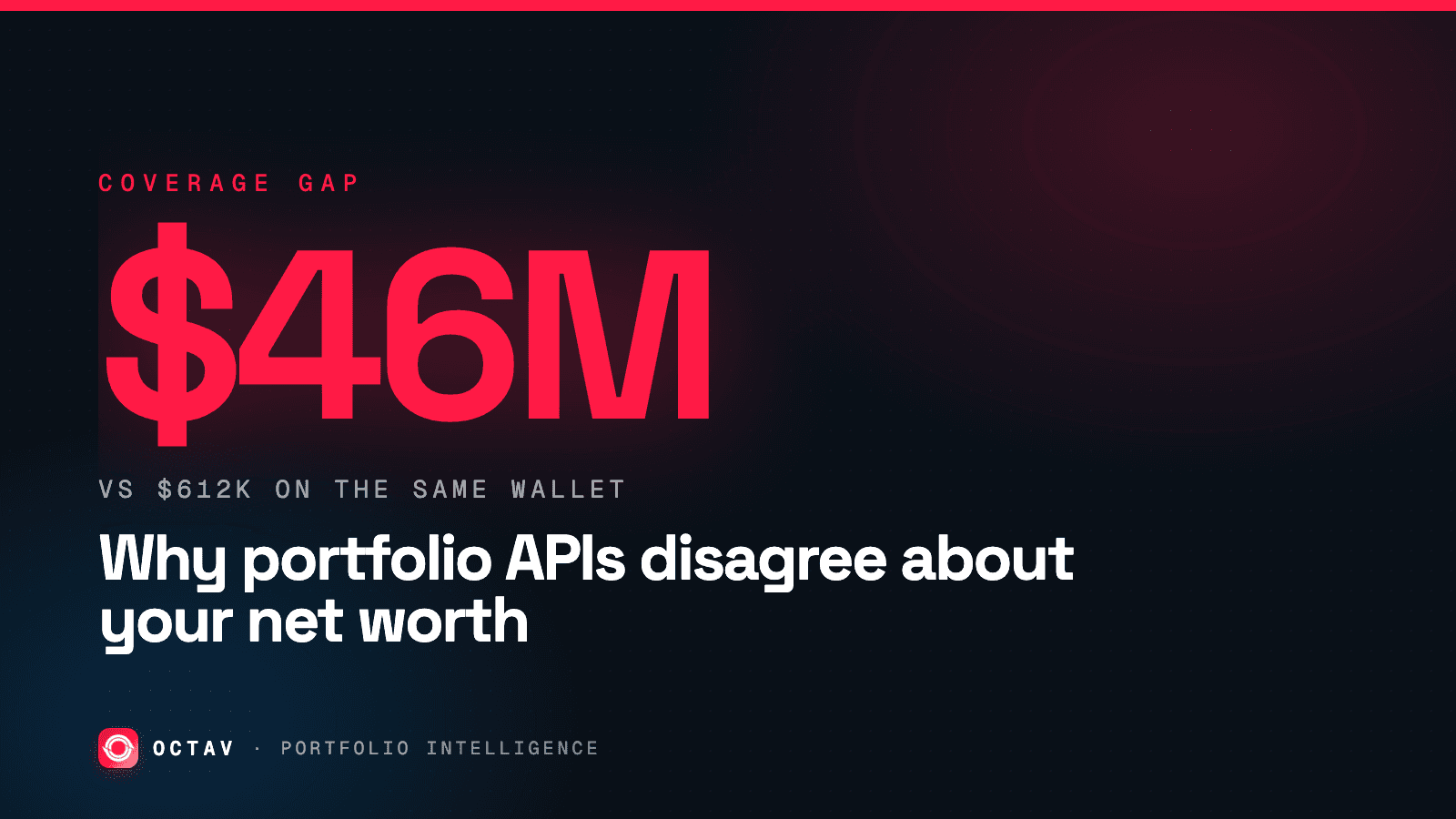
If two portfolio APIs return different net worth for the same address, the instinct is to blame price feeds. That is almost never the cause.
On a clean single-protocol Aave wallet, every EVM API in our nine-provider benchmark reconciles to within 0.2%. Prices are a solved problem. What is not solved is knowing what the wallet holds in the first place.
A balance query is not a portfolio
Ask an RPC node what an address holds and you get a list of token balances. For a wallet that only holds spot tokens, that list is the portfolio.
For a wallet that has done anything in DeFi, the tokens in it are receipts:
| What you hold | What a balance query sees | What it is worth |
|---|---|---|
| Supplied to Aave | aUSDC balance | Principal + accrued interest |
| LP on Uniswap | LP token balance | A share of the pool's current composition |
| Staked SOL via Jito | jitoSOL balance | Staked principal + rewards |
| Perp position on Hyperliquid | Nothing in the wallet | Margin + unrealised PnL |
| Options on Derive | Collateral token | The value of the options book |
The last two are the reason the gaps get extreme. A perp position is not a token at all — it is state inside a protocol. An API that only enumerates tokens cannot see it, and will not tell you it cannot see it. It returns a number that looks complete.
How large the gap gets
From the benchmark, same wallets, same day:
| Wallet | Token-only APIs | Full-decoding APIs |
|---|---|---|
| Multi-sector whale | $612.6k – $28.60M | $46.27M |
| Solana DeFi whale | ~$9.67M | $26.04M |
| Derive options book | ~$401.6k | $1.33M |
| Hyperliquid perp trader | ~$27k | $56k |
Reported net worth, same wallet, same day
Each row is scaled to its own maximum — these are four different wallets, so compare within a row, not across. Source: benchmark.octav.fi, 2026-07-13.
Across the wallet set the spread between token-only and full-portfolio APIs runs from 10× to 600×.
Four failure modes to test for
When you evaluate a provider, these are the specific things that break. Test them with a wallet you already know the answer for.
1. Silent omission. The API returns 200 OK with a partial portfolio and no indication that a sector was skipped. This is the dangerous one — an error you can handle, a confident wrong number you cannot.
2. Receipt tokens priced as tokens. An LST priced from a thin market rather than from the underlying stake. An LP token priced by its own market rather than by pool composition.
3. Double counting. The same value reported twice — once as the receipt token and once as the decoded position. Ask your provider whether it ships a price source per asset so you can audit which is which.
4. Chain gaps presented as zero. A provider without Solana support does not return "unsupported"; it returns a portfolio without the Solana half.
What to ask a provider
- Which sectors do you decode: lending, LP, staking, perps, options?
- Which chains have DeFi decoding, not just token balances?
- Do you return a price source per asset?
- What happens when a position type is unsupported — omitted, or flagged?
- How do you avoid double-counting receipt tokens?
The practical consequence
For a fund, this is not an academic problem. A NAV built on an API that misses a sector is wrong in a way no amount of downstream reconciliation will catch, because the missing positions never enter the pipeline. See What Is NAV Reporting for Crypto Funds? for how position enumeration feeds the rest of the process, and Tracking DeFi Positions Across Multiple Chains for why the problem multiplies per chain.
Keep reading
 Benchmarks & Comparisons
Octav vs Zerion: Which Sees More of Your Wallet
Zerion is fast and cheap but misses half a complex wallet. Octav decodes the full portfolio: DeFi, options, perps and Solana, with top benchmark coverage.
2 min read
 Benchmarks & Comparisons
Best Crypto Portfolio Trackers in 2026
Which crypto portfolio tracker fits which job, based on measured coverage data rather than feature lists — including where each one stops reading your wallet.
3 min read
 Benchmarks & Comparisons
Octav vs Mobula: Chain Breadth vs DeFi Depth
Mobula brings wide chain and market-data coverage at low cost. Octav decodes DeFi, options, perps and Solana with the top benchmark accuracy. Where each fits.
1 min read