Octav vs Nansen: Portfolio Data vs Analytics
Nansen is on-chain analytics: labels and smart-money flow. Octav is decoded portfolio data across DeFi, options, perps and Solana. Which one you actually need.
Nansen and Octav get compared because both touch wallets, but they answer different questions. Nansen tells you who is doing what on-chain — smart money, wallet labels, flow. Octav tells you what a wallet actually holds, decoded and priced across every chain. If you need an accurate portfolio, that second question is the one that matters, and it is Octav's whole job.
 Octav
Octav Nansen
Two different products
Nansen is an analytics platform. Its value is labelled intelligence: which wallets are accumulating, where flows are heading, what "smart money" is doing. That is research, not portfolio accounting.
Octav is a portfolio data engine — an API and an app on one backend — built to resolve any address into every decoded position: lending, LP, staking, vaults, perps and options, valued at the block timestamp. In our nine-provider benchmark Octav scored the maximum on coverage and DeFi decoding; Nansen, measured on the same wallets, scored lower on coverage and at the bottom on cost.
| Nansen | Octav | |
|---|---|---|
| Primary job | On-chain analytics, wallet labels | Decoded portfolio data (API + app) |
| Portfolio decoding | Secondary to analytics | The core product |
| Benchmark coverage | 67 | 100 |
| Options / perps / Solana DeFi | Limited | Fully decoded |
| Cost | Premium | Credit-based, free tier |
| Best for | Research and flow analysis | Getting the portfolio number right |
The same data in the API or the app
Everything the Octav API returns is also in the app, free to use at pro.octav.fi — search any address and read the full decoded portfolio, no analytics subscription required.
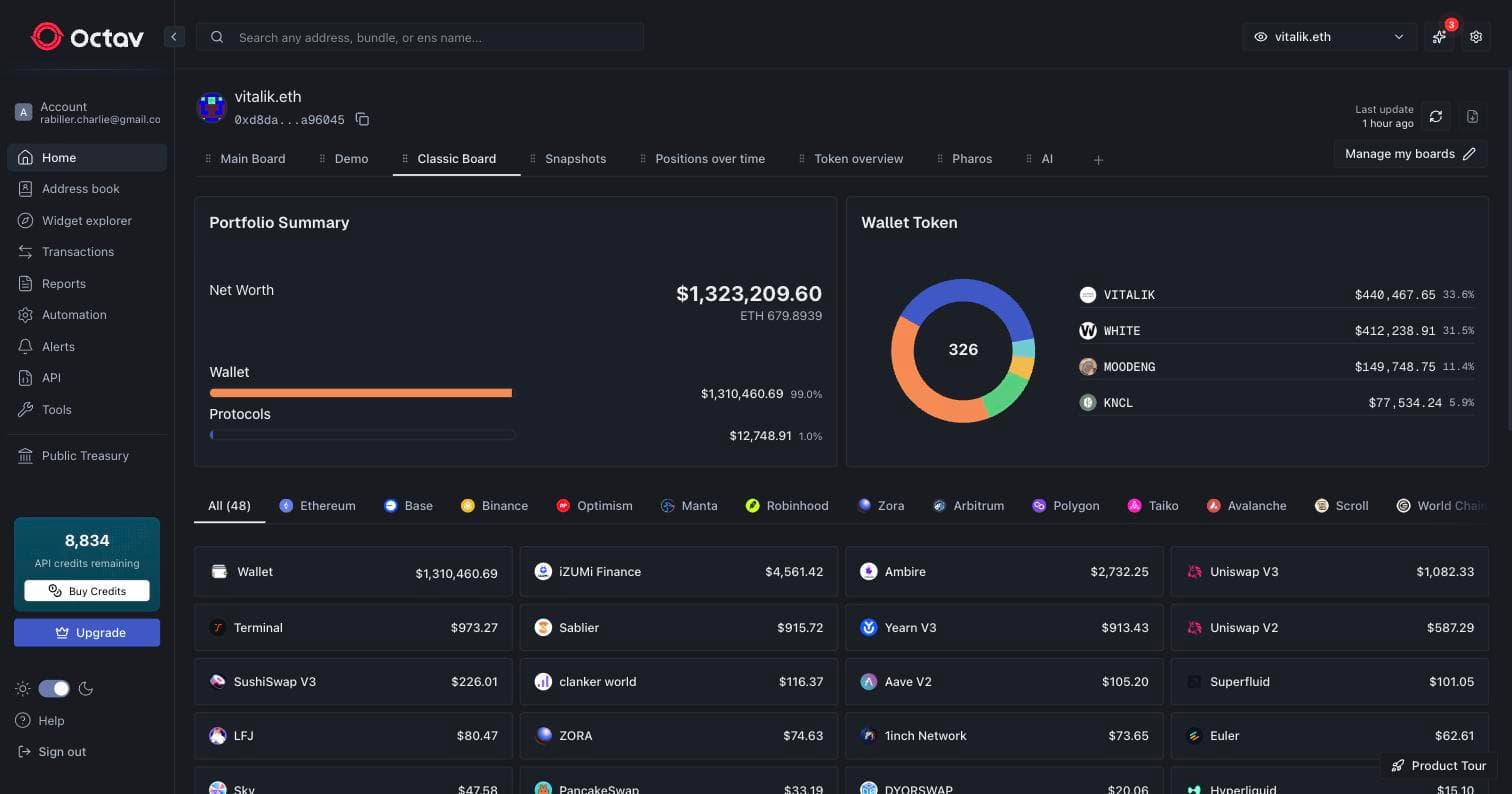
One wallet, 48 chains, every protocol position resolved individually — Aave, Yearn, Euler, Uniswap, Hyperliquid — priced and categorised.
Why Octav wins for portfolio accuracy
Analytics tools optimise for signal, not for reconciling every position in a wallet to a correct dollar value. When the goal is an accurate portfolio — for reporting, NAV, tax, or a product you are building — coverage and decoding accuracy dominate, and that is measured, not asserted: Octav ties the top benchmark scores and is the only provider tested that also decodes options, perps and Solana DeFi. See Octav vs DeBank vs Zerion for the head-to-head against the other API leaders.
Which should you pick?
- Nansen — if you want research: smart-money tracking, labels and flow analytics.
- Octav — if you want the portfolio itself decoded correctly, as an API to build on or a free app to look at.
They are complements as often as alternatives. Start with any wallet at pro.octav.fi, or read the benchmark for the method behind the numbers.
Keep reading
 Benchmarks & Comparisons
Octav vs Zerion: Which Sees More of Your Wallet
Zerion is fast and cheap but misses half a complex wallet. Octav decodes the full portfolio: DeFi, options, perps and Solana, with top benchmark coverage.
2 min read
 Benchmarks & Comparisons
Octav vs Mobula: Chain Breadth vs DeFi Depth
Mobula brings wide chain and market-data coverage at low cost. Octav decodes DeFi, options, perps and Solana with the top benchmark accuracy. Where each fits.
1 min read
 Benchmarks & Comparisons
The Crypto Portfolio API Benchmark: 9 Providers
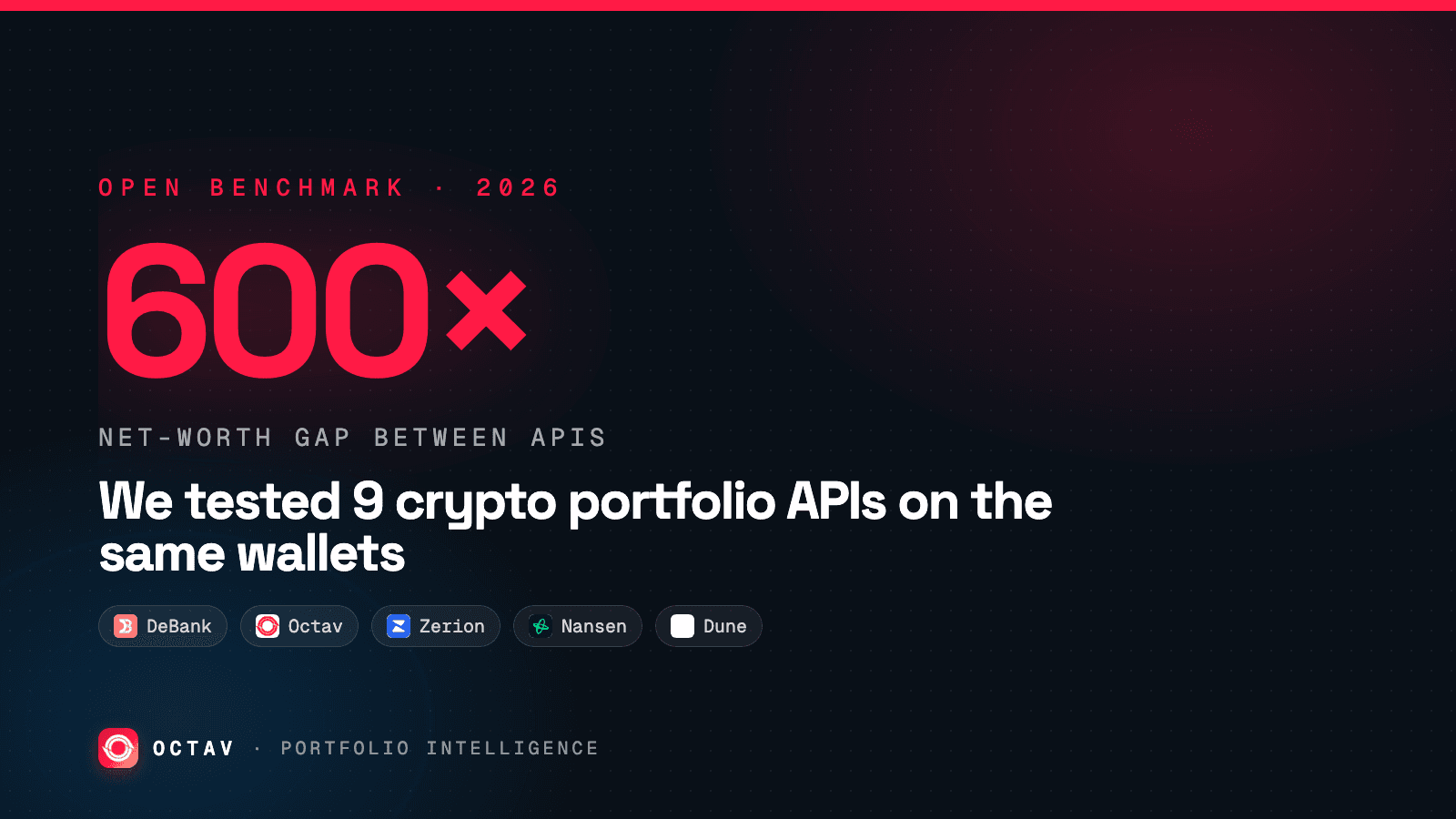
We ran 17 real wallets through 9 crypto portfolio APIs and diffed the results. DeFi decoding moved reported net worth by 10x to 600x. Full scorecard inside.
3 min read