Daily Crypto Portfolio Snapshots Explained
On-chain history is not portfolio history. Why point-in-time snapshots have to be recorded going forward, and what they unlock for reporting and audit.
"The blockchain is immutable, so I can always reconstruct my portfolio" is true in the way that "the library has all the books" is true. The raw material exists. Turning it back into a valued, position-level portfolio as of a given day is a different problem.
Why history cannot simply be recomputed
To rebuild what a wallet was worth on a past date you need, for that date:
| Input | Why it is hard retroactively |
|---|---|
| Every position held | Requires protocol state at that block, not just balances |
| Protocol logic as it was then | Contracts get upgraded; today's decoder may not fit |
| Prices at that timestamp | Historical price data for long-tail assets is patchy |
| Protocols that existed then | Some have shut down, been exploited, or migrated |
The last one is the killer. A protocol that no longer runs cannot be queried for what your position was worth in it. That value is not recoverable from an archive node without a decoder that still understands the old contract.
This is why snapshots record forward. Octav Snapshots captures a full portfolio every day from the moment you subscribe, kept for a year. The best day to start was a year ago; the next best is today.
curl -s -X POST https://api.octav.fi/v1/subscribe-snapshot \
  -H "Authorization: Bearer $OCTAV_API_KEY" \
  -H "Content-Type: application/json" \
  -d '{"addresses": ["0xYourAddress"]}'
Subscription costs 1200 credits; the recurring cost is $30/year per address.
Reading history back is /v1/historical at one credit per call — see the
endpoint reference.
What snapshots make possible
Reproducible NAV. A NAV you cannot re-derive six months later is not one an auditor can sign off. Snapshots are what makes prior NAVs reproducible rather than recomputed — the distinction that matters in NAV reporting.
Performance attribution. Comparing today's portfolio to a stored snapshot separates "the market moved" from "we changed the position". Without stored history you can measure the first but not the second.
Quarter-end reporting. Investor reporting needs the portfolio as of a specific date, not as of whenever the report was generated.
Audit trails. An auditor asking "what did you hold on 31 March" wants a record made on 31 March, not a reconstruction made in July.
Snapshots vs at-block queries
Two different tools, often confused:
| Snapshots | Portfolio at Block | |
|---|---|---|
| Direction | Records forward from subscription | Queries backward to any block |
| Coverage | Full portfolio, all chains | Ethereum, Linea, Monad — block-level |
| Availability | Only since you subscribed | Any block, no setup required |
| Cost | $30/yr per address | 1 credit + add-on fee |
| Best for | Routine reporting, audit trails | One-off historical questions |
Use at-block for investigating a specific past moment. Use snapshots for anything you will need repeatedly and on a schedule.
The operational point
Snapshots are cheap and the decision is asymmetric. $30 per address per year against the cost of not being able to answer a regulator, an auditor or an investor about a date that has already passed.
The failure mode is silent: nothing goes wrong until someone asks a question about the past, at which point the data either exists or it does not. There is no way to fix it retroactively.
For treasuries that want that history public rather than internal, see Transparency Dashboards for DeFi Treasuries.
Keep reading
 Portfolio Management
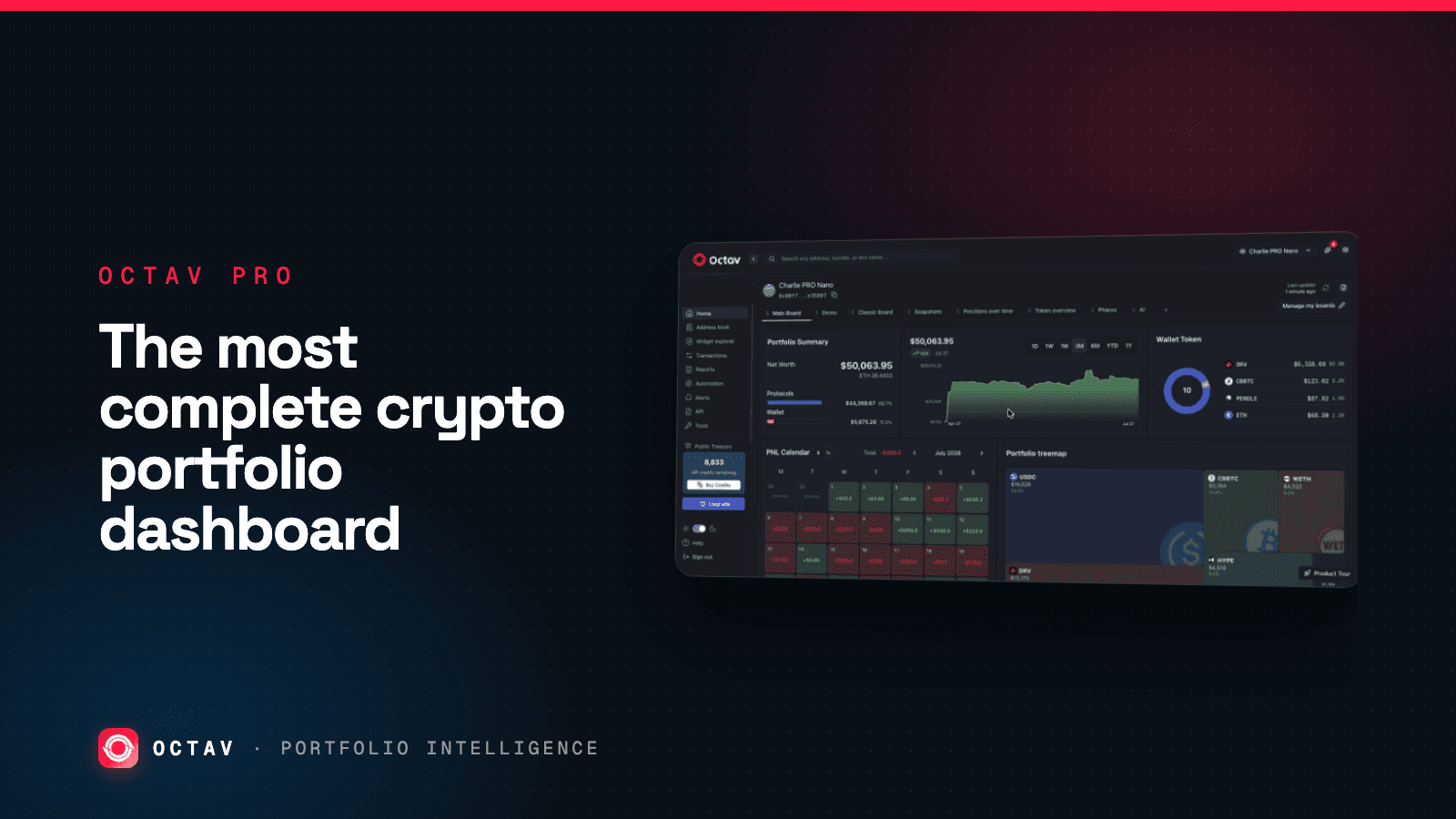
The Most Complete Crypto Portfolio Dashboard
Octav Pro is the most complete crypto portfolio dashboard: customizable widget boards over benchmark-best data across DeFi, options, perps and Solana.
4 min read
 Portfolio Management
Crypto Portfolio Tracker: Track Any Wallet Free
Track any wallet's full crypto portfolio free — tokens and DeFi, options, perps and Solana decoded across 50+ chains, with no account and no private keys.
3 min read
 Portfolio Management
Crypto Portfolio Management for Funds
The operating stack a digital asset fund needs — position enumeration, valuation, exposure, NAV, reconciliation and reporting — and where each stage breaks.
2 min read