Crypto Portfolio Management for Funds
The operating stack a digital asset fund needs — position enumeration, valuation, exposure, NAV, reconciliation and reporting — and where each stage breaks.
Managing a digital asset portfolio at fund scale is five distinct problems that get treated as one. Most operational pain comes from solving them in the wrong order — usually by starting at reporting and working backwards.
The stack
| Stage | Question it answers | Fails when |
|---|---|---|
| 1. Enumeration | What do we hold? | A sector is silently missing |
| 2. Valuation | What is it worth? | Prices come from inconsistent sources |
| 3. Exposure | What are we exposed to? | Value is confused with exposure |
| 4. NAV | What is the fund worth? | The number cannot be reproduced |
| 5. Reconciliation | Why did it change? | Transactions are unlabelled |
Each stage depends entirely on the one above it. A perfect NAV process built on incomplete enumeration produces a precise wrong answer, and no downstream control will catch it — the missing positions never entered the pipeline.
Stage 1 is where funds actually lose
Enumeration sounds like the easy part and is the part that breaks. A fund's balance sheet is spread across wallets, exchanges, custodians, lending markets, liquidity pools, staking, vesting contracts and derivatives venues — across however many chains the strategy touches.
The measured consequence, from our nine-provider benchmark: token-only data sources reported between $612.6k and $28.60M for a wallet worth $46.27M. That is a 10× to 600× range depending on how much the source could decode.
If stage 1 is wrong, stages 2–5 are theatre.
Stage 3: value is not exposure
For spot holdings the two are identical, which is why the distinction gets lost. They diverge as soon as leverage appears.
| Position | Value | Exposure |
|---|---|---|
| $1M spot ETH | $1M | $1M ETH |
| Aave: $1M supplied, $400k borrowed | $600k net | $1M ETH long, $400k USDC short |
| $50k perp margin, 10× | $50k | $500k notional |
A risk limit written against value and a risk limit written against exposure are different limits. See Tracking Aave Positions and Tracking Hyperliquid Perps.
Stage 4: reproducibility beats accuracy
An auditor's question is rarely "is this number right today". It is "show me how you arrived at it, and show me the same number again in six months".
That requires point-in-time records rather than recomputation, because protocols get upgraded, deprecated and shut down — see Daily Crypto Portfolio Snapshots and What Is NAV Reporting for Crypto Funds?.
Stage 5: label once, not every quarter
Reconciliation is mostly a classification problem, and most of it is mechanical. The work is making the machine handle the repetitive majority and routing only genuine ambiguity to a human — plus knowing your own address book so internal transfers are never booked as disposals. See Crypto Transaction Reconciliation for Audits.
Build or buy
Teams reliably underestimate stage 1 and overestimate stages 2–5.
Valuation, exposure, NAV and reporting are ordinary finance engineering — real work, but bounded, and your team understands your mandate better than a vendor will. Enumeration is unbounded: it scales with protocols × chains × versions, it never stops changing, and being 95% complete is indistinguishable from being 100% complete right up until it is not.
Before signing with anyone, run the vendor review: Security Questions to Ask a Portfolio Vendor and check the certification actually says what you think — What SOC 2 Type 2 Means.
The pragmatic split most funds land on is to buy enumeration and valuation as data, and build the parts that encode their own policy. What to look for is in How to Choose a Crypto Portfolio API.
Where to start
If you are standing this up now, in this order:
- Get a complete address inventory. Everything, including dormant wallets.
- Verify enumeration against wallets you can check by hand.
- Turn on snapshots before you need history — it cannot be backfilled.
- Fix one price source and timestamp convention, and write it down.
- Only then build reporting.
Keep reading
 Portfolio Management
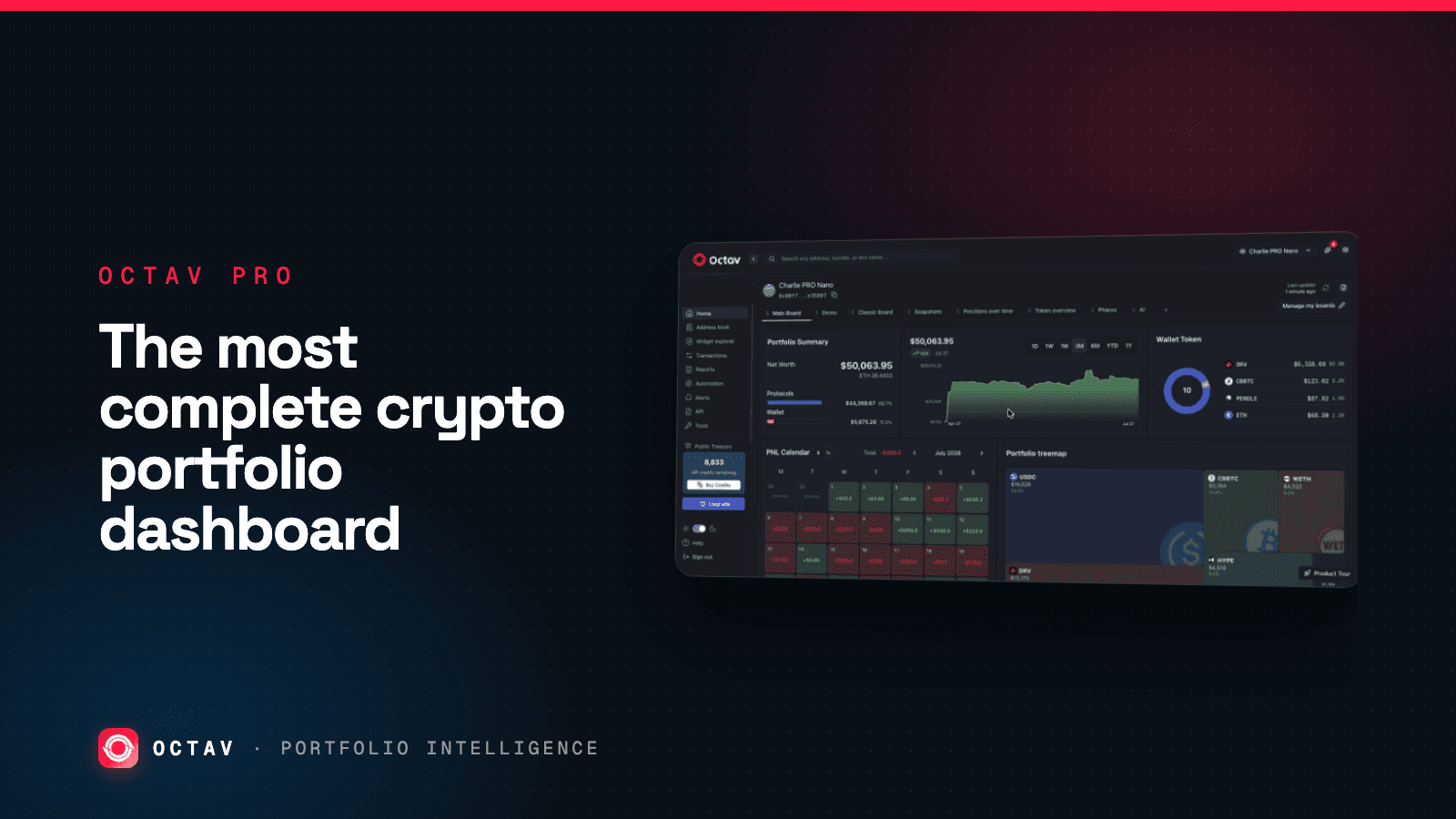
The Most Complete Crypto Portfolio Dashboard
Octav Pro is the most complete crypto portfolio dashboard: customizable widget boards over benchmark-best data across DeFi, options, perps and Solana.
4 min read
 Portfolio Management
Crypto Portfolio Tracker: Track Any Wallet Free
Track any wallet's full crypto portfolio free — tokens and DeFi, options, perps and Solana decoded across 50+ chains, with no account and no private keys.
3 min read
 Portfolio Management
Daily Crypto Portfolio Snapshots Explained
On-chain history is not portfolio history. Why point-in-time snapshots have to be recorded going forward, and what they unlock for reporting and audit.
2 min read