How to Choose a Crypto Portfolio API
A buyer's guide to evaluating crypto portfolio APIs — the tests to run, the questions vendors dislike, and the trade-offs between coverage, cost and latency.
Every portfolio API demo looks identical: paste an address, see a portfolio. The differences only surface on wallets that are hard, at volumes that cost money, in month three of an integration.
Here is how to find them in an afternoon instead.
Disclosure: we build one of these. The evaluation below is the one we would run against ourselves, and the benchmark it draws on ranks a competitor above us overall.
Step 1: test with a wallet you already understand
Not the vendor's demo address — a wallet whose contents you can independently verify. Most providers have a free entry point for exactly this; ours is Authless, which needs no key at all.
Ideally one holding: spot tokens, a lending position, an LP position, something staked, and — if relevant to you — a perp or an option. Then compare the API's answer against the protocol UIs.
The single most useful question is whether the total is right. It sounds trivial. It is the whole test, because the category's failure mode is a plausible number rather than an error.
Step 2: ask the questions vendors find awkward
| Question | What a weak answer sounds like |
|---|---|
| Which sectors do you decode? | "We support all major protocols" |
| What happens when a position type is unsupported? | "That doesn't really happen" |
| Do you return a price source per asset? | "We use aggregated pricing" |
| How do you avoid double-counting receipt tokens? | Silence, or a rewritten question |
| What is p95 latency on a complex wallet? | A number for a simple wallet |
| What does a busy address cost to index? | A per-call price with no sync cost |
The second row matters most. "Omitted silently" and "flagged as unsupported" are very different products, and only one of them is safe to build reporting on.
Step 3: price the real workload
Per-call pricing is misleading on its own. Model your actual pattern:
- How many addresses, polled how often?
- Does the provider let you batch addresses into one call? (One call with three addresses should cost one unit, not three.)
- Is there a one-off indexing cost for busy addresses? Octav charges one credit per 250 transactions on first sync, which is trivial per wallet and material across a fund's whole address book.
- What does caching give you? Portfolio data cached for a minute means a dashboard refresh is not a new charge.
Step 4: weigh the three-way trade-off
Coverage, cost and latency pull against each other. Decoding positions across many protocols takes time and infrastructure; providers that skip it are faster and cheaper — but on any wallet with real DeFi, Solana, options or perps they hand you a number that is simply wrong, which no amount of speed makes up for.
| Your situation | Optimise for |
|---|---|
| Simple token wallets, high volume | Cost and latency |
| Complex DeFi wallets | Coverage, and accept the latency |
| User-facing hot path | Latency, with caching in front |
| Fund reporting | Coverage and reproducibility |
The benchmark makes the trade-off concrete: Zerion scores 99 on cost and 92 on performance with coverage at 48; Octav scores 100 on coverage with cost at 54 and performance at 40. For simple EVM spot tokens, optimise for cost. For anything with real DeFi, Solana, options or perps — which is most active wallets — Octav resolves the most of it, most accurately, and that is what "best" actually means. See Octav vs DeBank vs Zerion.
Step 5: check what happens after integration
Things that only matter later, and are painful to retrofit:
- Historical data. Can you ask what a portfolio was worth last quarter? Most providers cannot, because it has to be recorded forward.
- Freshness signals. Is there a way to know how current the data is?
- Agent access. If AI agents will consume this, is there an MCP server or CLI?
- Response stability. Will the shape change under you?
The short checklist
- Query a wallet you understand. Is the total right?
- Add a Solana address. Does the total change correctly?
- Ask what happens on an unsupported position type.
- Model the real call volume, including first-sync costs.
- Ask for a portfolio as of a past date.
If a provider passes all five, the rest is implementation detail — and the implementation itself is covered in Crypto Portfolio API: A Practical Guide.
Keep reading
 API & Developers
Portfolio at Block: A Complete Guide
Query a wallet's exact decoded portfolio at any historical block on Ethereum, Linea and Monad — decoded Uniswap V4 everywhere, V3 on Linea.
3 min read
 API & Developers
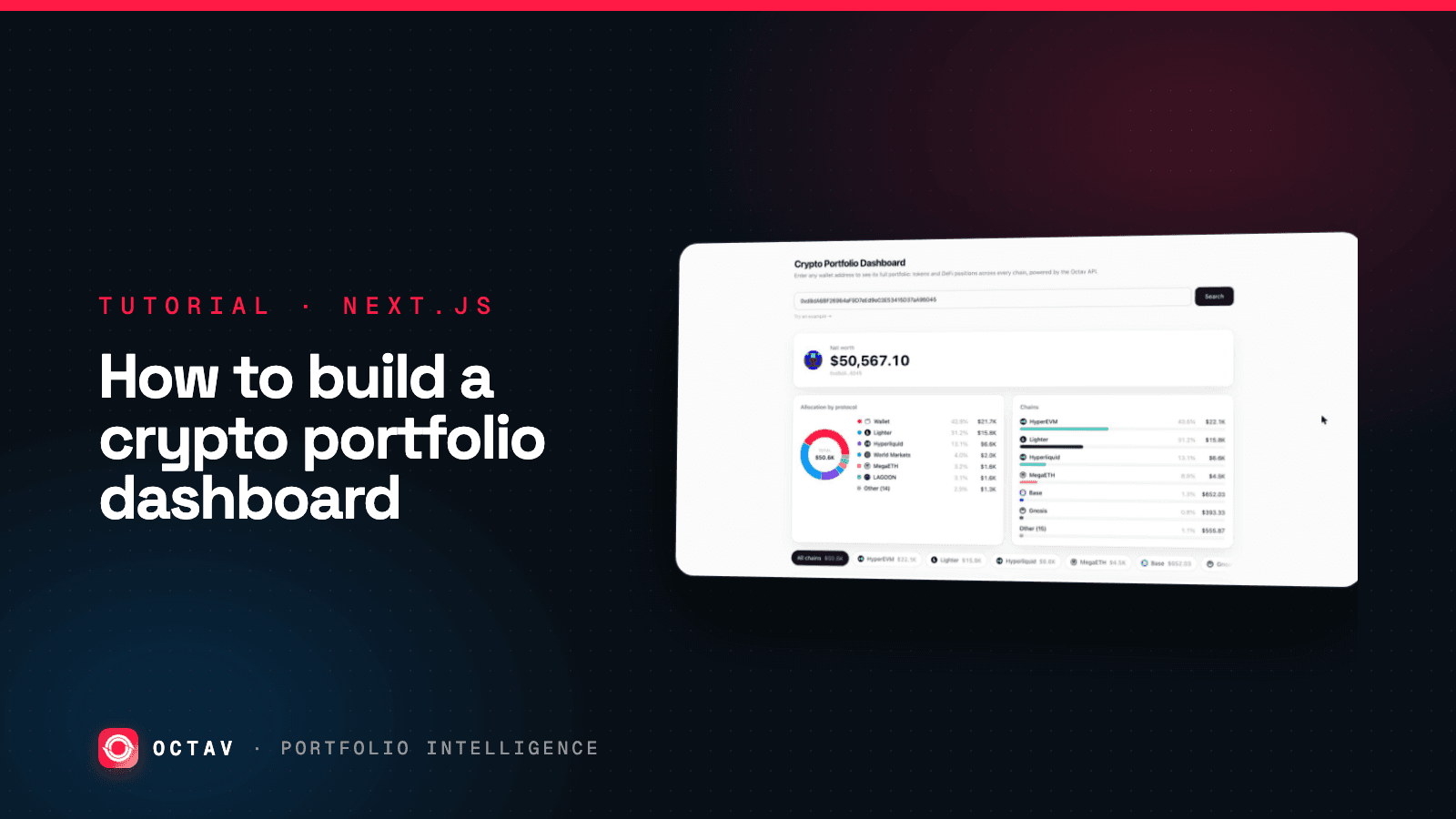
Build a Crypto Portfolio Dashboard: A Complete Guide
Step-by-step guide to building a crypto portfolio dashboard in Next.js with the Octav API: search any wallet, decode tokens and DeFi across 50+ chains.
7 min read
 API & Developers
Crypto Portfolio API Endpoint Reference
Every Octav API endpoint with its parameters, credit cost and response, plus authentication, rate limits and caching behaviour for building on portfolio data.
2 min read