Try a Portfolio API Without an API Key
Authless lets you check any EVM portfolio and visualise transactions with no account, no key and no server-side storage — useful for evaluating coverage fast.
The slowest part of evaluating a portfolio API is usually not the integration. It is getting a key: a signup, a sales call, a trial that starts before you have had time to test anything.
Octav Authless removes that step. Paste an EVM address, see the decoded portfolio and its transactions. No account, no key, no server-side storage of what you looked up.
What it is for
Checking coverage before you commit. The only evaluation that matters is whether an API sees what your wallets actually hold. Authless lets you run that test in a minute rather than a week — take an address you understand and see whether the lending, LP and staking positions appear.
Explaining a wallet to someone. Sending a colleague a decoded portfolio view is more useful than a block explorer link, which shows transactions rather than positions.
Debugging. When a portfolio number looks wrong in your own integration, Authless gives you an independent read of the same address without touching your key or your credit balance.
What it is not
It is not the product. Deliberately:
| Authless | The API |
|---|---|
| EVM addresses | EVM, Solana, Hyperliquid |
| A UI | JSON in your own systems |
| No history | Historical and snapshot data |
| No rate guarantees | 360 requests/minute, defined caching |
| Nothing stored | Subscriptions, credits, sync status |
If you are building on the data, you want the API. Authless exists to answer "is this worth integrating" honestly and quickly.
The test worth running
Take a wallet whose contents you can verify independently — ideally one with a lending position and something staked — and check three things:
- Does the total match what you know is there?
- Are protocol positions decoded, or only tokens listed?
- Are the transactions labelled with protocol and action, or just hashes?
Question 1 is the whole evaluation. The failure mode across this category is not an error, it is a plausible number missing a sector — the subject of Why Portfolio APIs Disagree About Net Worth.
Then run the same wallet through a competitor. That is the exercise our nine-provider benchmark automates, and you can reproduce a slice of it by hand in ten minutes.
Where it sits
Authless is one of several free, no-commitment entry points — alongside Octav Perps for funding rates and the protocols explorer for coverage. The full map is in Every Octav Tool and When to Use It.
For the paid path and what it costs, see How to Choose a Crypto Portfolio API.
Keep reading
 API & Developers
Portfolio at Block: A Complete Guide
Query a wallet's exact decoded portfolio at any historical block on Ethereum, Linea and Monad — decoded Uniswap V4 everywhere, V3 on Linea.
3 min read
 API & Developers
Build a Crypto Portfolio Dashboard: A Complete Guide
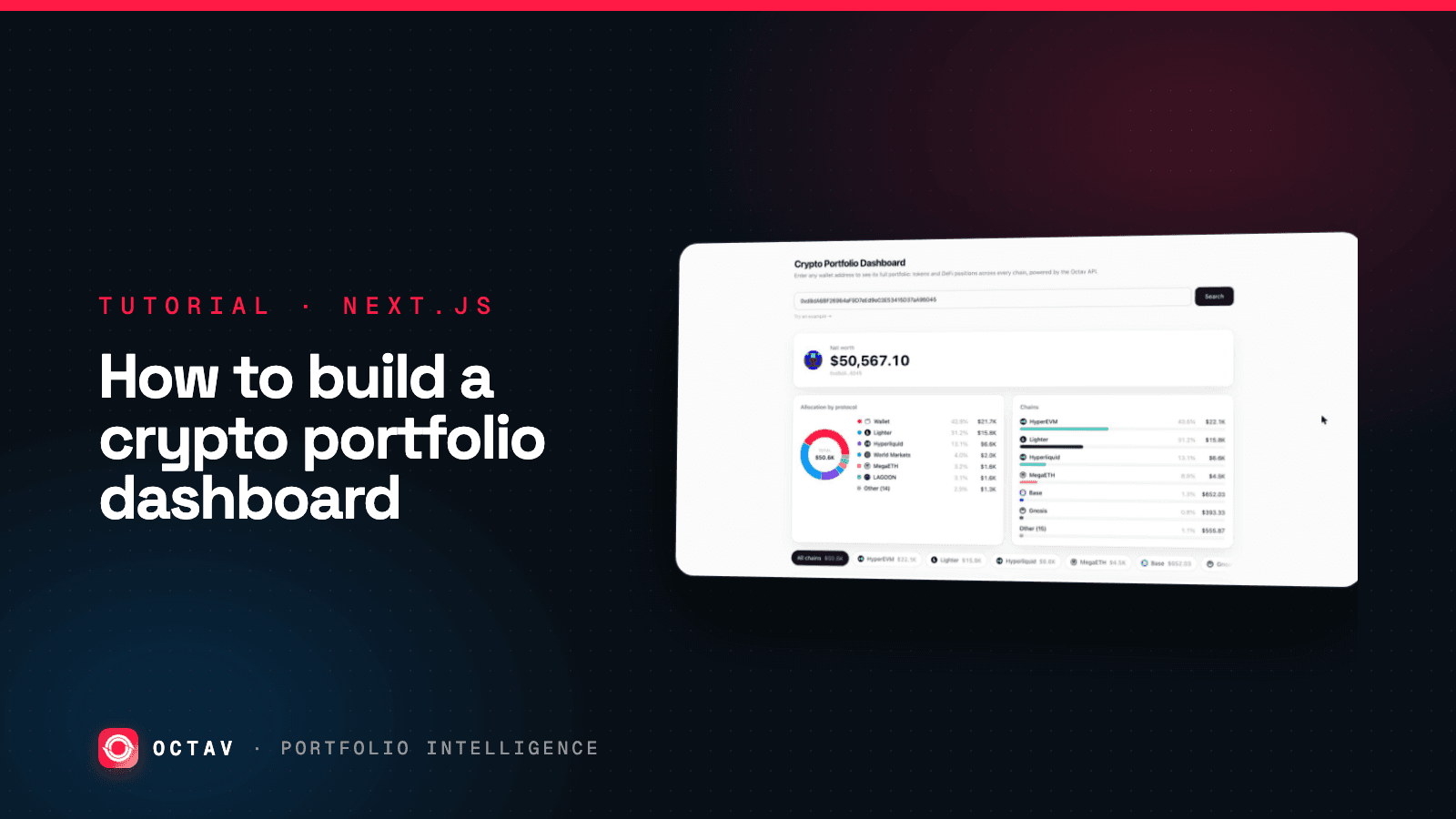
Step-by-step guide to building a crypto portfolio dashboard in Next.js with the Octav API: search any wallet, decode tokens and DeFi across 50+ chains.
7 min read
 API & Developers
How to Choose a Crypto Portfolio API
A buyer's guide to evaluating crypto portfolio APIs — the tests to run, the questions vendors dislike, and the trade-offs between coverage, cost and latency.
3 min read