Embed a Live Crypto Portfolio Widget
Add a live multi-chain portfolio view to any site with one iframe, no frontend build required, and when to use the raw API instead of a widget.
Not every portfolio integration needs a frontend project. If what you want is a live portfolio view inside an existing product, docs site or investor page, an iframe is enough.
Widget Studio is a no-code builder for exactly that:
design the widget, theme it, copy one <iframe>.
The three steps
- Get an API key from data.octav.fi.
- Buy credits — from $10.
- Paste the embed snippet.
<iframe
  src="https://studio.octav.fi/embed?address=0xYourAddress&theme=light"
  width="100%"
  height="640"
  frameborder="0"
  title="Live crypto portfolio"
></iframe>
The widget renders the same decoded data the API returns — tokens plus DeFi positions across 50+ chains, themed to your brand.
When a widget is the right call
| Use a widget when | Use the API when |
|---|---|
| You want a portfolio view, not portfolio data | You need the numbers in your own logic |
| No frontend team available | You are building custom UI |
| Embedding in docs, marketing or an investor page | Feeding NAV, risk or accounting systems |
| Time-to-ship matters more than control | You need to transform or store the data |
The honest version: a widget is a display surface. The moment you need to compute something from the data — an allocation, a P&L, a NAV — you want the API.
Public transparency pages
A related use is the fully public version: a page anyone can visit showing a treasury or vault's live positions. That is what Transparency Dashboards are for, covered in Transparency Dashboards for DeFi Treasuries.
The distinction: a widget is a component you place inside your own page; a transparency dashboard is a hosted page you point people at.
Trying it without a key
Octav Authless lets you check portfolios and visualise transactions for any EVM address with no key and no server-side storage. It is the fastest way to see what the decoded data looks like before committing to an integration.
Practical notes
Rate limits are shared. The widget draws on the same 360 requests/minute per key as everything else. A widget on a high-traffic page is not free.
Caching applies. Portfolio data caches for one minute, so the widget is live-ish rather than real-time. For most investor-facing pages that is the right trade.
Theming is per-widget. Build one per brand context rather than trying to restyle a single embed with CSS from the parent page — the iframe boundary will stop you.
Keep reading
 API & Developers
Crypto Portfolio API: A Practical Guide
What a crypto portfolio API returns, how to fetch multi-chain balances, DeFi positions and transaction history from one, and the mistakes to avoid.
2 min read
 API & Developers
Portfolio at Block: A Complete Guide
Query a wallet's exact decoded portfolio at any historical block on Ethereum, Linea and Monad — decoded Uniswap V4 everywhere, V3 on Linea.
3 min read
 API & Developers
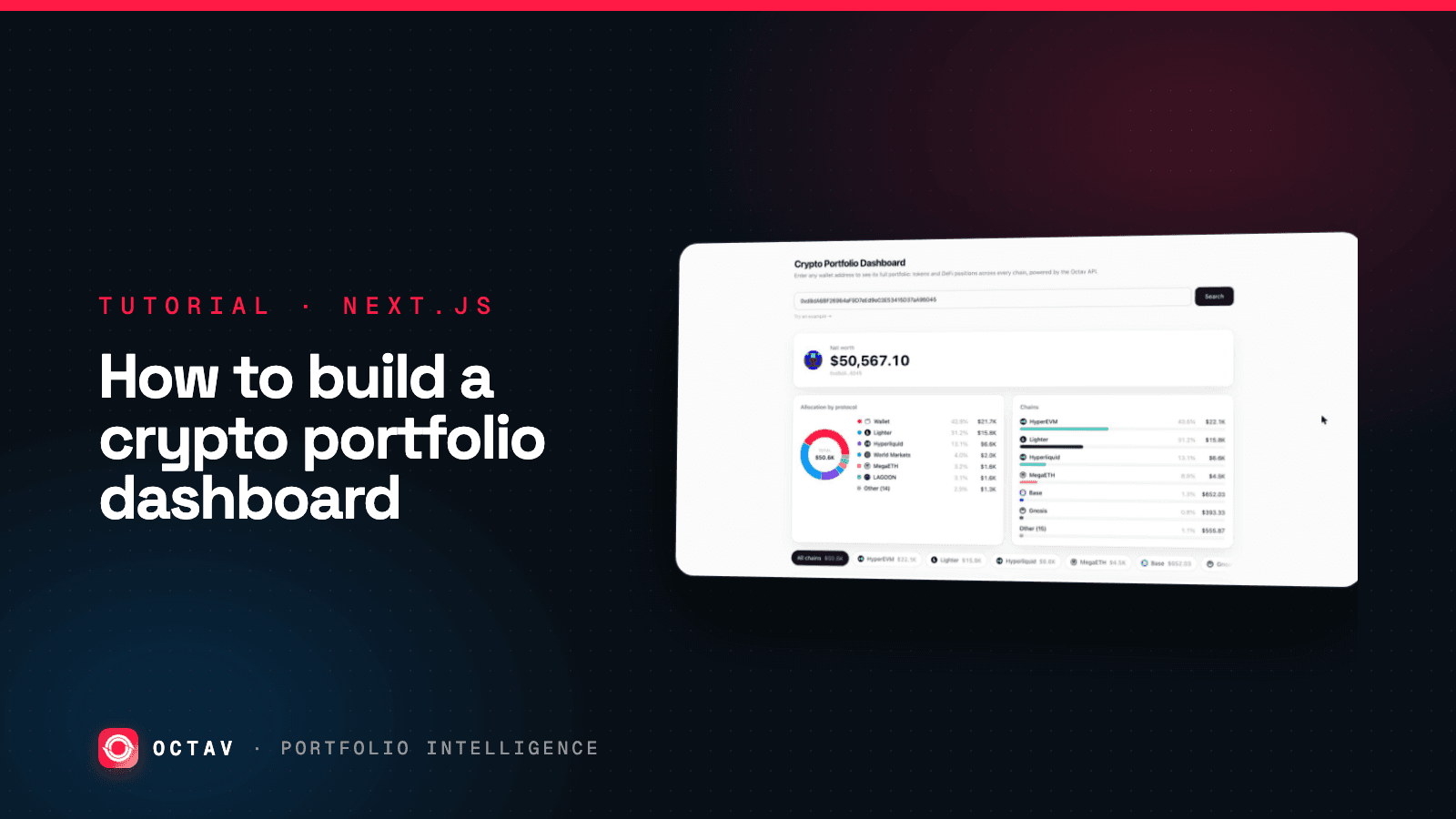
Build a Crypto Portfolio Dashboard: A Complete Guide
Step-by-step guide to building a crypto portfolio dashboard in Next.js with the Octav API: search any wallet, decode tokens and DeFi across 50+ chains.
7 min read