Octav vs CoinStats: Which Portfolio Data Wins
CoinStats aggregates exchanges and wallets for consumers. Octav decodes DeFi, options, perps and Solana with benchmark-proven accuracy. When each one wins.
If you want to see spot balances from your exchanges and wallets in one consumer app, CoinStats does that well. If you need the on-chain portfolio to be correct — every lending, LP, staking, perp and options position decoded and priced across every chain — that is a different problem, and it is the one Octav is built to solve.
The short version: CoinStats aggregates, Octav decodes. Aggregating a list of tokens from connected accounts is not the same as reading what a wallet actually controls on-chain, and the gap is largest exactly where the money is — inside DeFi protocols.
 Octav
Octav CoinStats
What CoinStats is built for
CoinStats is a consumer portfolio tracker. Its strength is breadth of connections: link exchange accounts and wallets and see a combined balance in a polished mobile app. For someone tracking mostly spot holdings across a few CEXs and chains, that is genuinely useful.
Where a consumer aggregator runs out of road is depth. A DeFi position is not a token sitting in the wallet — it is a claim held as protocol state, and turning it back into "you own $X of this" means decoding each protocol. That is infrastructure work, not an integration checkbox.
What Octav is built for
Octav is a portfolio data engine — an API and an app on the same backend — whose entire job is resolving an address into every decoded position, priced, across chains. In our nine-provider benchmark it scored the maximum on both coverage and DeFi decoding, and it is the only provider measured that also decodes options, perps and Solana DeFi.
| CoinStats | Octav | |
|---|---|---|
| Primary job | Consumer multi-account tracker | Decoded portfolio data (API + app) |
| DeFi position decoding | Basic | Full — lending, LP, staking, vaults |
| Perps (Hyperliquid, Lighter) | Limited | Decoded |
| Options (Derive) | No | Decoded |
| Solana DeFi | Token-level | Fully decoded |
| Benchmarked accuracy | Not measured | 100 coverage, 100 DeFi decoding |
| Free to use | App | App and free-tier API |
The same data in the API or the app
Everything the API returns is in the Octav app too — free to use at pro.octav.fi. Search any address and you get the full decoded portfolio: net worth, allocation, wallet tokens and every protocol position across every chain the wallet touches.
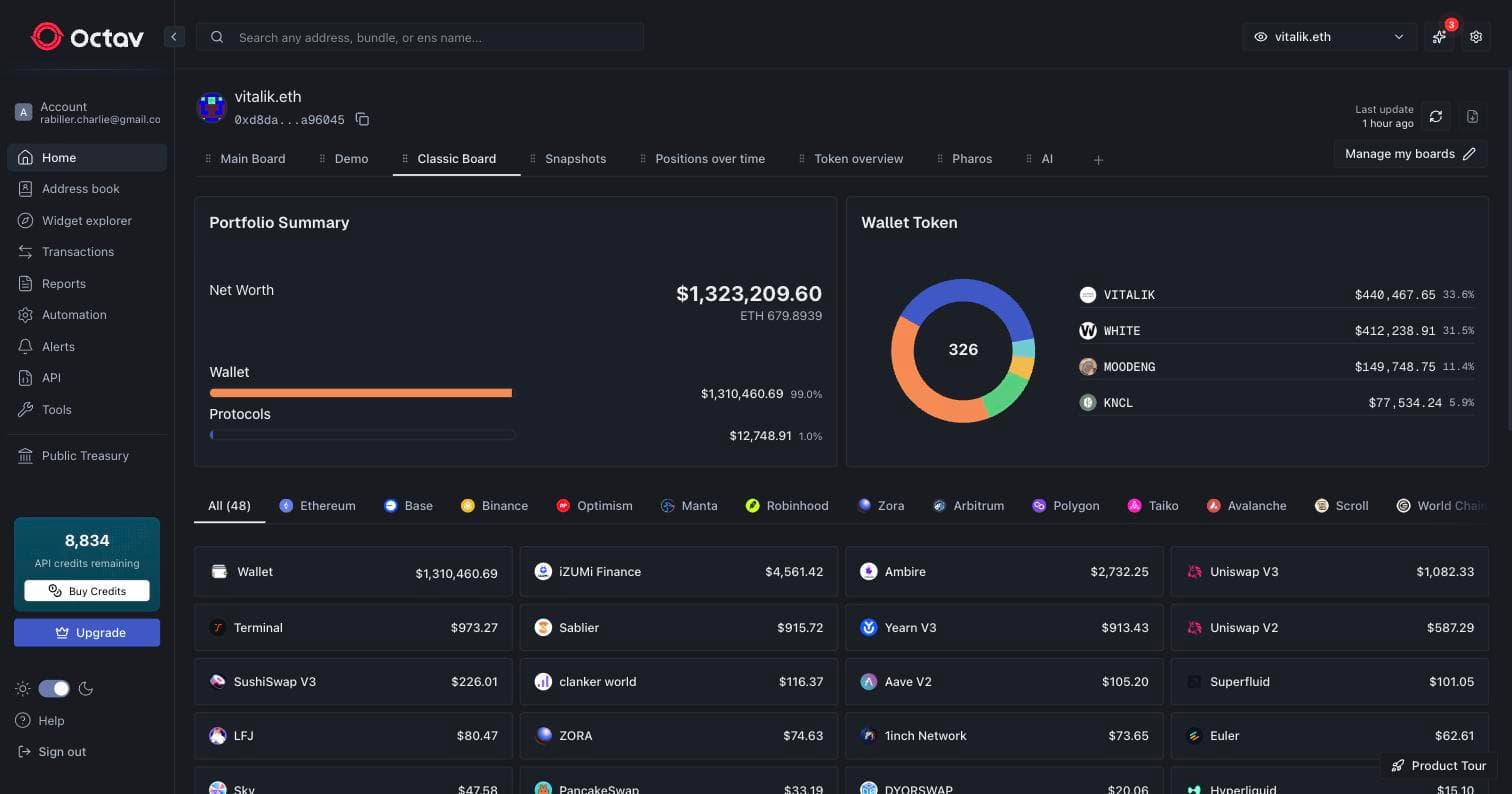
That is one address resolved across 48 chains, with Uniswap, Aave, Yearn, Euler, Sablier and Hyperliquid positions decoded individually — not folded into a single opaque balance.
Why the difference matters
An aggregator that reads DeFi as a token list does not return an error when it misses a position. It returns a confidently wrong number. For an active wallet, the majority of value can live inside protocols — see why portfolio APIs disagree about net worth and tracking DeFi positions across chains.
We do not ask you to take that on faith. The benchmark harness is open and the weights are published, so you can re-run it on your own wallets.
Which should you pick?
- CoinStats — if you mainly want a consumer app that ties your exchange accounts and wallets together for a spot overview.
- Octav — if the on-chain number has to be right: DeFi, perps, options and Solana decoded, available as an API to build on and as a free app to look at.
Try it now on any wallet at pro.octav.fi, or read the full benchmark to see how the coverage gap was measured.
Keep reading
 Benchmarks & Comparisons
Best Crypto Portfolio Trackers in 2026
Which crypto portfolio tracker fits which job, based on measured coverage data rather than feature lists — including where each one stops reading your wallet.
3 min read
 Benchmarks & Comparisons
Octav vs Zerion: Which Sees More of Your Wallet
Zerion is fast and cheap but misses half a complex wallet. Octav decodes the full portfolio: DeFi, options, perps and Solana, with top benchmark coverage.
2 min read
 Benchmarks & Comparisons
Octav vs CoinLedger: Live Portfolio vs Tax Tool
CoinLedger is crypto tax software; its portfolio tracker is a filing by-product. Octav is the live, decoded multi-chain portfolio data that feeds tools like it.
2 min read