Octav vs CoinLedger: Live Portfolio vs Tax Tool
CoinLedger is crypto tax software; its portfolio tracker is a filing by-product. Octav is the live, decoded multi-chain portfolio data that feeds tools like it.
CoinLedger markets a "portfolio tracker," but it is a crypto tax product first — its tracking is a by-product of cost-basis accounting for filing. Octav is a live, decoded portfolio across every chain and protocol. They are not really competitors: Octav is the accurate data source, and it exports straight into CoinLedger's format when it is time to file.
If you are choosing what to see your portfolio in, that distinction decides it.
 Octav
Octav CoinLedger
A tax tool is not a live portfolio API
Tax software is built to reconstruct historical cost basis from transactions and produce a filing. It is not built to decode, in real time, what a wallet holds right now across dozens of protocols — lending, LP, staking, vaults, perps and options — and value each position at the current price. Those are different jobs with different engines.
That is why a tax tool's "tracker" tends to read on-chain DeFi shallowly. It does not need deep live decoding to do taxes; Octav's entire product is deep live decoding.
| CoinLedger | Octav | |
|---|---|---|
| Primary job | Crypto tax filing (cost basis) | Live decoded portfolio (API + app) |
| Real-time DeFi decoding | Shallow | Full — lending, LP, staking, vaults |
| Options / perps / Solana DeFi | No | Fully decoded |
| Benchmarked coverage | Not measured | 100 coverage, 100 DeFi decoding |
| Relationship | Consumes Octav's export | Feeds the tax tool |
The same data in the API or the app
Everything the Octav API returns is in the app too, free to use at pro.octav.fi. Search any address for the full decoded portfolio across every chain it touches.
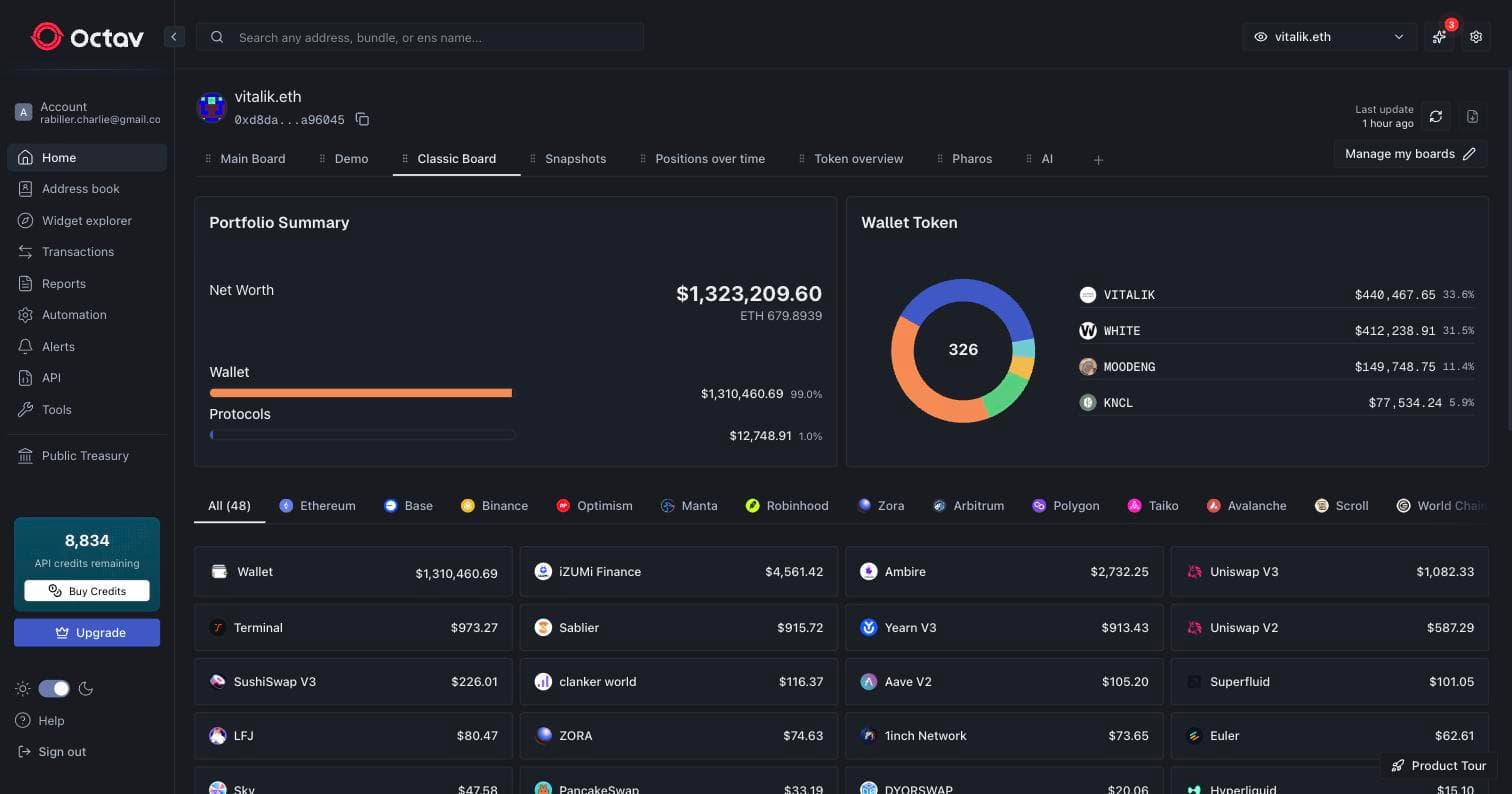
That is a live portfolio — 48 chains, Aave, Yearn, Euler, Uniswap and Hyperliquid positions decoded individually. A tax product shows you last year's disposals; Octav shows you what the wallet holds now, and it is the only tool in our benchmark that also decodes options, perps and Solana DeFi.
Use both, in the right order
The clean workflow is Octav for the data, your tax tool for the filing:
- Octav decodes and prices the full multi-chain history and live positions.
- Export it in CoinLedger's exact CSV schema — or Koinly, TaxBit, and seven others — from the transactions exporter.
- File in the tool you already use.
Which should you pick?
- CoinLedger — when your job is filing a crypto tax return.
- Octav — when you want an accurate live portfolio across DeFi, options, perps and Solana, as an API or a free app — and the clean data that feeds the filing.
See it on any wallet at pro.octav.fi, or read the benchmark.
Keep reading
 Benchmarks & Comparisons
Best Crypto Portfolio Trackers in 2026
Which crypto portfolio tracker fits which job, based on measured coverage data rather than feature lists — including where each one stops reading your wallet.
3 min read
 Benchmarks & Comparisons
Octav vs CoinStats: Which Portfolio Data Wins
CoinStats aggregates exchanges and wallets for consumers. Octav decodes DeFi, options, perps and Solana with benchmark-proven accuracy. When each one wins.
2 min read
 Benchmarks & Comparisons
Octav vs Zerion: Which Sees More of Your Wallet
Zerion is fast and cheap but misses half a complex wallet. Octav decodes the full portfolio: DeFi, options, perps and Solana, with top benchmark coverage.
2 min read