Solana Portfolio API: A Complete Guide
What it takes to read a Solana wallet properly — SPL tokens, staking, lending and perps — and why Solana coverage varies so much between providers.
Protocols covered
 Solana
 Kamino
 Jupiter
 Jito
Jito
Solana is the chain where portfolio API coverage varies most. On an EVM wallet the major providers broadly agree. On an active Solana wallet they can differ by nearly 3× — $26.04M against ~$9.67M on the same address in our benchmark.
This guide covers what a Solana portfolio actually contains and what to require from a provider.
Why Solana is harder than an EVM chain
It is not that Solana is more complex. It is that Solana support is a separate engineering investment rather than a configuration change.
| EVM chains | Solana | |
|---|---|---|
| Address format | 0x… hex | base58 |
| Account model | Contract storage | Program-derived accounts |
| Adding a new chain | Largely reuse existing decoders | A distinct integration |
| Token standard | ERC-20 | SPL |
A provider that supports ten EVM chains got most of that for free after the first. Nothing about that work transfers to Solana, which is why several providers simply do not offer it — and why coverage among those that do ranges from token balances to full position decoding.
What a Solana wallet holds
| Layer | Examples | Balance query sees |
|---|---|---|
| SPL tokens | USDC, JUP, BONK | Everything |
| Native staking | Stake accounts | Nothing — separate accounts |
| Liquid staking | jitoSOL, mSOL | A token, priced wrongly |
| Lending | Kamino, Jupiter Lend | An obligation, unreadable |
| Liquidity | Orca, Raydium | An LP token |
| Perps | On-chain perp venues | Nothing |
Only the first row is straightforward. Everything below it needs program-specific decoding, covered in depth in Tracking Solana DeFi Positions.
Querying Solana
Solana addresses go through the same endpoint as EVM addresses, which matters for anyone running a mixed portfolio:
curl -s https://api.octav.fi/v1/portfolio \
  -H "Authorization: Bearer $OCTAV_API_KEY" \
  -G --data-urlencode "addresses=<solana-address>,0x<evm-address>"
One call, one credit, both ecosystems, one response shape. The alternative — a Solana-specific provider alongside an EVM one — means two integrations, two price sources and a reconciliation problem between them.
Solana also has a dedicated endpoint that has no EVM equivalent:
curl -s https://api.octav.fi/v1/airdrop \
  -H "Authorization: Bearer $OCTAV_API_KEY" \
  -G --data-urlencode "addresses=<solana-address>"
Full parameters in the endpoint reference.
Choosing a Solana provider
Three questions, in order of how much they matter:
1. Is Solana DeFi decoded, or only SPL balances? This is the 3× question. Ask specifically about Kamino and Jupiter Lend rather than about "Solana support" in the abstract.
2. Are LSTs valued from the underlying stake? jitoSOL and mSOL accrue
against SOL, so pricing them as loose tokens understates the position — the same
mechanism described in
Valuing stETH and Liquid Staking.
3. Is Solana in the same call as EVM, or a separate product? This determines whether you build one integration or two.
Octav is the most complete answer here: it reads Solana DeFi more fully than any other multi-chain provider measured, and unlike a Solana-only tool it follows the same wallet onto EVM in one call. Two honest caveats: TopLedger is Solana-native and scores 70 on coverage but 9 on chain breadth, so it cannot leave Solana; and Octav's benchmark performance score is 40, because decoding this much takes time. See Octav vs DeBank vs Zerion.
For AI agents
If an agent is analysing Solana wallets, the silent-omission problem is worse than for humans, because the agent has no prior about what should be there. See A Crypto Portfolio MCP Server for AI Agents.
The EVM side of the same question — where the difficulty is chain count rather than program decoding — is in the EVM portfolio API guide.
Keep reading
 Chains
EVM Portfolio API: A Complete Guide
Reading an EVM wallet means every chain it has touched, not just Ethereum — plus the receipt tokens, NFT positions and proxies that break naive decoding.
4 min read
 API & Developers
Portfolio at Block: A Complete Guide
Query a wallet's exact decoded portfolio at any historical block on Ethereum, Linea and Monad — decoded Uniswap V4 everywhere, V3 on Linea.
3 min read
 API & Developers
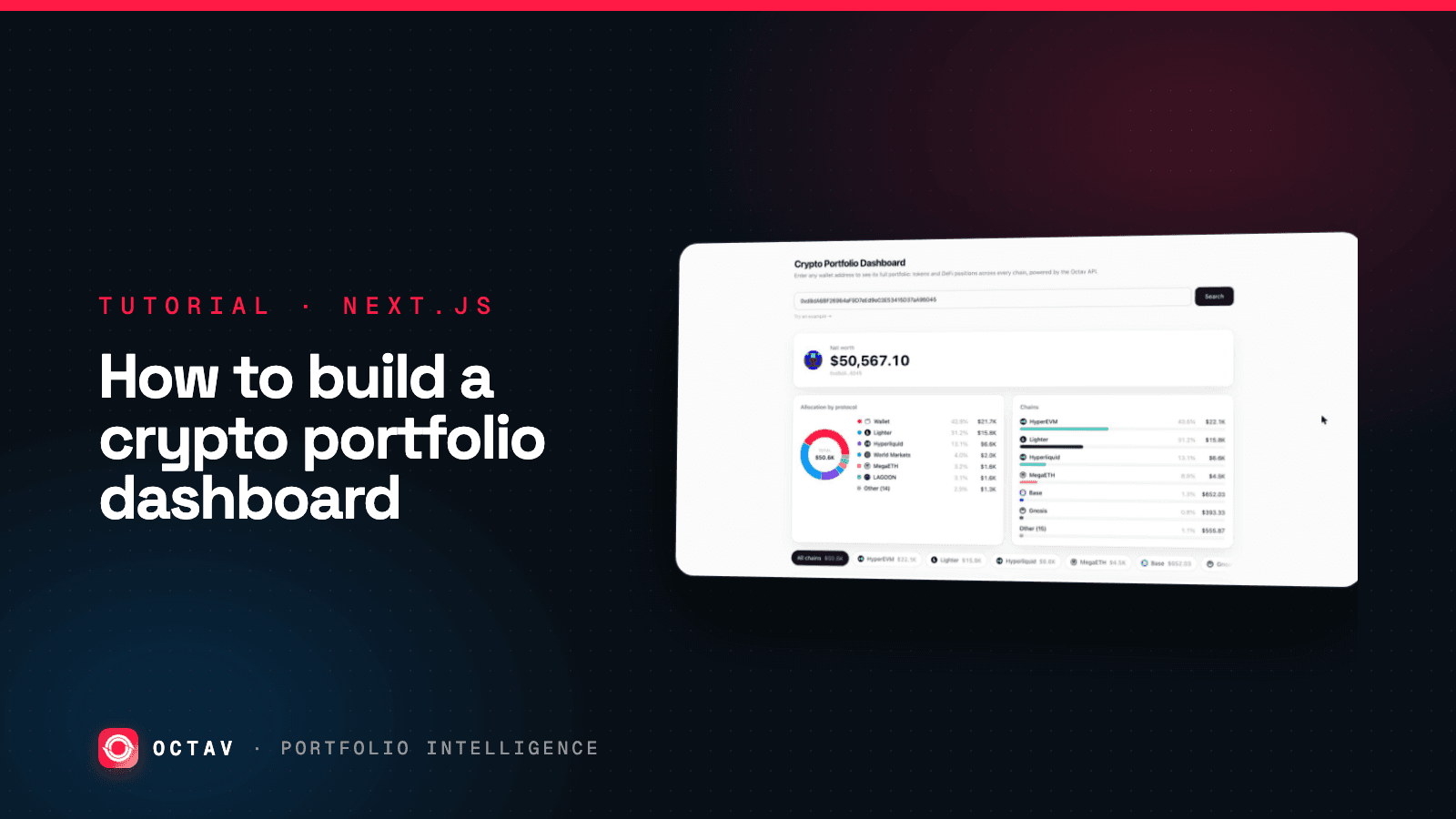
Build a Crypto Portfolio Dashboard: A Complete Guide
Step-by-step guide to building a crypto portfolio dashboard in Next.js with the Octav API: search any wallet, decode tokens and DeFi across 50+ chains.
7 min read